

Relaxed regulations help to encourage exploration of scientific frontiers, create industry with global reach
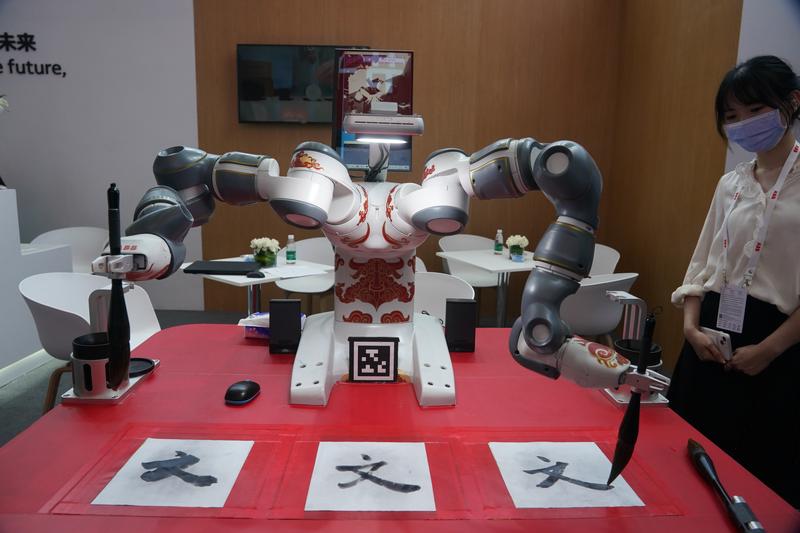 A smart robot showcases its calligraphy skill during the fifth World Artificial Intelligence Conference in Shanghai on Sept 1, 2022. (GAO ERQIANG / CHINA DAILY)
Shanghai’s decision to boost the development of its artificial intelligence, or AI, industry will promote the city’s digital transformation and its efforts to build itself into an international AI highland, experts said.
On Sept 22, the city’s legislature passed a regulation on boosting AI, marking the first such effort at provincial or municipality level in China. The regulation will take effect on Oct 1.
“This legislation, with the aim to promote (the AI industry), places emphasis on industry innovation and guidance for future development,” said Yan Rui, director of legal affairs in the Standing Committee of the Shanghai Municipal People’s Congress.
By giving full play to effective market and top-notch governance, the regulation intends to facilitate various incentives for the high-quality development of the AI industry, Yan said.
“Being the city’s second bylaw in the digital economy, the regulation on AI will strongly support the digital transformation of Shanghai, and assist the creation of an AI highland with global influence.”
One highlight of the AI regulation is that the municipal departments concerned could draw up lists of minor infractions during the development of the AI industry, which would not receive administrative punishment.
A certain degree of tolerance for such infractions is aimed at encouraging exploration of scientific frontiers and inspiring innovation, said Weng Guanxing, a lawyer at Shanghai-based law firm Wintell & Co.
“The essence of scientific research is that it is a process of constantly making mistakes and distinguishing right from wrong. So is AI. Therefore, it is also an international convention to allow for minor errors during the research and development process,” Weng said.
The regulation gives a clear definition of AI and the AI industry, clearly defines government and various related divisions’ responsibilities and management standards, and encourages innovative activities in the field by people, enterprises and organizations — all within the framework of established laws and regulations.
“The regulation stresses the importance of establishing a standard for AI that ranges from algorithm performance and data security, to privacy protection, product compatibility and more,” said Shi Zhiru, vice-president of Dgene Inc.
“This will greatly promote the formation of a collaborative industrial chain, and to ensure the healthy and orderly development of the AI industry,” he said.
AI is one of the three leading industries along with integrated circuits and biomedicine that Shanghai is striving to develop by concentrating resources.
Local authorities will promote the building and use of public computing resource platforms and provide public computing power support for AI technology and industrial development, according to the regulation.
It also seeks to promote overall innovation and breakthroughs in the AI industry by supporting the development of AI related core industries and strengthening the agglomeration of AI enterprises.
The city will explore grading management and sandbox supervision, a flexible supervision system for technological innovation, to stimulate the innovation capacity of various entities and expand the development space for the AI industry, it said.
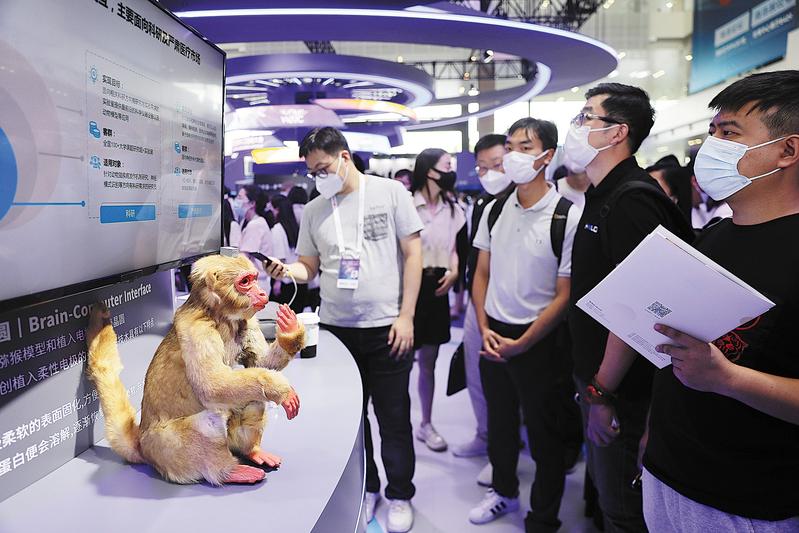 A model of a monkey installed with a brain-computer interface attracts visitors at the conference. (PHOTO PROVIDED TO CHINA DAILY)
In early September Shanghai was the setting for a global event showcasing the use of AI for a wide variety of commercial purposes.
Ranging from general-purpose chips to financial technology, and from smart healthcare to wearable devices, the benefits of AI were highlighted at the Fifth World Artificial Intelligence Conference, or WAIC, which took place from Sept 1 to 3.
In particular, a group of intelligent robots equipped with AI technologies attracted widespread attention. Experts said the goal for AI research and development is to improve human livelihoods.
Isabel Ge Mahe, Apple’s vice-president and managing director for China, said, “We are full of hope for the future of machine learning, as we strongly believe it can inspire more innovation, therefore improving people’s lives.”
CloudMinds Robotics Co, which is based in Shanghai, has launched Cloud Ginger 2.0, a new smart service robot that can perform a variety of functions, including reception work, tour guidance, elderly care, cleaning, as well as education and scientific research.
Shaped like a human, and equipped with nimble hands, the robot has 41 intelligent flexible executors and sensors. It can listen, speak, see and move based on multiple cloud intelligent technologies.
Bill Huang, the company’s founder and CEO, said, “Reports show there will be about 310 million people who are 60 or older in China by 2035 — offering promising market demand for service robots.”
Liu Yu, executive vice-president and chief commercial officer at Shanghai MicroPort MedBot (Group) Co, said in a speech at WAIC: “Medical service is probably one of the things that people care about the most, because health is most important. To meet such requirements, we provide solutions that cover operations from head to toe.”
The company’s robots, which include those for vascular intervention, orthopedic operations and laparoscopic procedures, can conduct minimally invasive surgeries.
“Now, with the help of a robot, doctors can perform laparoscopic operations in shielded rooms by using a computer mouse. Such advances have greatly reduced the difficulties of performing such surgery,” Liu said.
“The outlook for robotic surgery is extremely promising, and we are going to develop more such robots and reduce the cost of surgery performed by them. Our fundamental goal is to make all surgeries easy to conduct,” Liu added.
Su Hua, global senior vice-president and president of the China region for Infineon Technologies, which designs and manufactures a range of semiconductor products, said that in many cutting-edge areas of technology, China has a number of companies that can lead the nation’s low-carbon development and that of the world as a whole.
Clobotics, a company based in Shanghai that focuses on computer vision and machine learning technology, tapped into this trend by giving Sparrow, its latest wind blade inspection and maintenance robot, its China debut at WAIC.
George Yan, founder and CEO of Clobotics, said the robot collects blade data via the company’s self-developed robotic platform to conduct maintenance and repair work — enhancing the efficiency of wind power.
Deep Robotics, based in Hangzhou, capital of Zhejiang province, presented China’s first industrial waterproof quadruped robot, the Jueying X20, which can easily step over an obstacle 20 centimeters high, navigate a stairwell, and climb a 30-degree slope.
The robot can also adapt to a variety of environments and conditions such as grasslands, sand, snowfields, gravel roads and puddles.
Cai Yinghua, vice-president of Alibaba Group and president of Alibaba Cloud Global Sales, said: “More and more of our enterprises are directly or indirectly applying AI. Some 58 percent of Chinese enterprises are applying it, while globally, the proportion is merely 35 percent.”
Industry experts said that regardless of AI’s rapid development, more efforts are needed to promote its wider applications, both in terms of technology and commercialization.
Gong Zheng, mayor of Shanghai, said the city has basically formed a complete industrial chain, and the scale of AI has grown significantly.
Shanghai’s AI industry scale has expanded significantly in the past few years.
In 2021, the combined output value of AI enterprises above a designated size, or with an annual revenue of 20 million yuan ($16.85 million) or above, reached 305.68 billion yuan, 2.28 times that of 2018, according to China Securities Journal.
The number of talented professionals working in the AI field in Shanghai has soared from 100,000 in 2018 to 230,000 in 2021, said a Xinhua News Agency report.
