

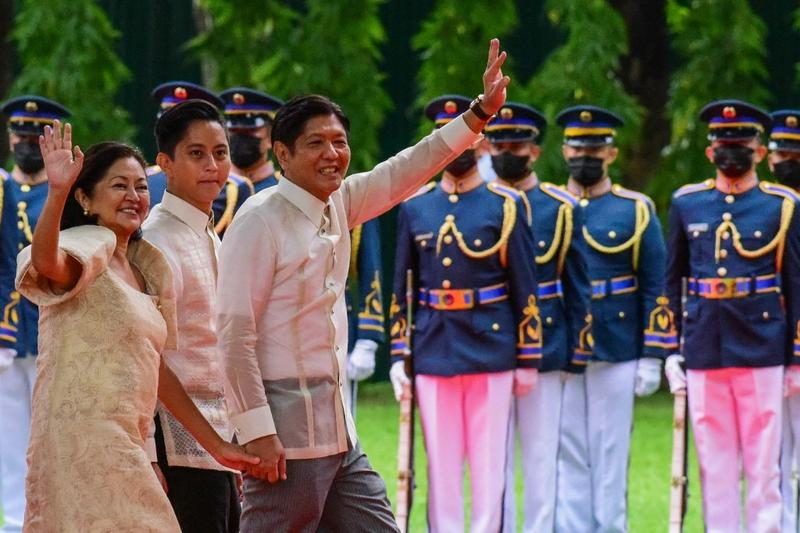
 New Philippine President Ferdinand Marcos Jr, accompanied by his wife Louise (left), and son and Congressman Sandro Marcos (2nd left) arrive at the Malacanang presidential palace, following his inauguration ceremony in Manila on June 30, 2022. (MARIA TAN/AFP)
The new President of the Philippines, Ferdinand Marcos Jr, said his government is putting the country’s growth trajectory back on track with a comprehensive, all-inclusive plan for economic transformation.
Sworn in on June 30 as the 17th president of the Philippines, Ferdinand Marcos Jr officially started his six-year term to lead a nation grappling with the challenges of the COVID-19 pandemic, rising commodity prices and a high fiscal deficit
Sworn in on June 30 as the 17th president of the Philippines, Marcos officially started his six-year term to lead a nation grappling with the challenges of the COVID-19 pandemic, rising commodity prices and a high fiscal deficit.
More known as “Bongbong”, Marcos alluded to “troubling times” in an inauguration speech delivered shortly after he was sworn into office at the National Museum of Fine Arts in Manila.
“These are troubling times. What’s happening to others can happen to us, but it will not,” the new president said.
“The pandemic ravaged bigger economies than ours. The virus is not the only thing to blame. What had been well built was torn down. We will build it back better,” he said.
ALSO READ: Marcos sworn in as the Philippines' 17th president
Marcos also promised to continue his predecessor Rodrigo Duterte’s flagship infrastructure program, better known as “Build, Build, Build”.
“Following these giant steps, we will continue to build (infrastructure). I will complete on schedule the projects that have been started. I am not interested in taking credit; I want to build on success that’s already happening,” he said.
Ruben Carlo Asuncion, chief economist of Union Bank of the Philippines, welcomed Marcos’ commitment to continue the Build, Build, Build program, as infrastructure is needed for an economic rebound. He is hoping that Marcos will give more details about his plan in his first State of the Nation Address, to be delivered at the opening of the 19th Congress in July.
Marcos, 64, won the May elections with 31 million votes, making him the first majority president since 1986, after a popular uprising ousted his father, Ferdinand Marcos Sr. Hounded by allegations of plunder and human rights violations, the elder Marcos and his family went into exile in Hawaii, in the United States. He died in 1989 from kidney, heart and lung ailments.
Ferdinand Marcos Jr. was sworn into office by Supreme Court Chief Justice Alexander Gesmundo. Marcos’ wife, lawyer Louise Araneta-Marcos, three sons, mother Imelda and sisters Imee and Irene witnessed the oath taking.
ALSO READ: Philippines' Marcos vows to foster stronger ties with China
Vice-President Sara Duterte and three former Philippine presidents, Fidel Ramos, Joseph Estrada and Gloria Macapagal-Arroyo, attended the event. Foreign dignitaries including Chinese Vice President Wang Qishan, Australian Governor-General David Hurley, Vietnamese Vice President Vo Thi Anh Xuan. Thai Deputy Prime Minister Don Pramudwinai were also present.
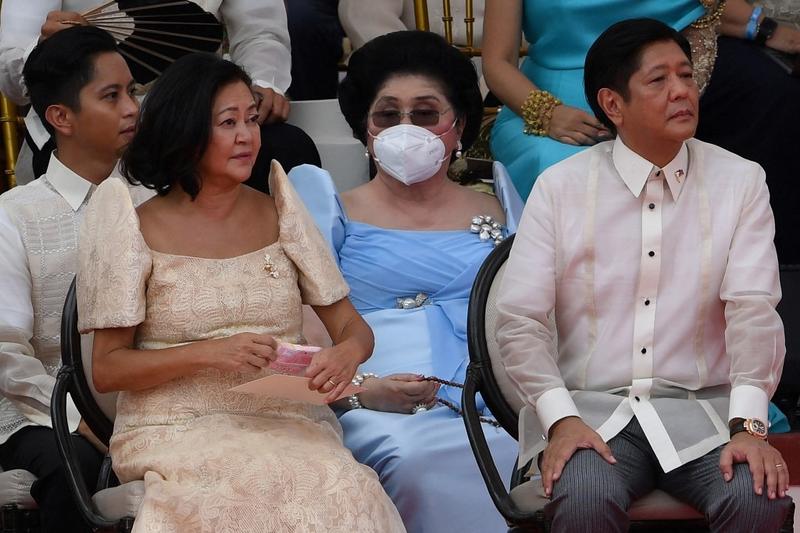 Former Philippine first lady Imelda Marcos (center) sits next to her son, new President Ferdinand Marcos Jr (right), daughter-in-law Louise (front left) and grandson and Congressman Sandro Marcos (back left) during the presidential inauguration ceremony at the National Museum in Manila on June 30, 2022. (TED ALJIBE / AFP)
Apart from focusing on infrastructure and the impact of the pandemic, Marcos emphasized the two key priorities of his administration: food security and climate change.
“The rich world talks a great deal but does a lot less about it than those with much less, but (who) have suffered more death and destruction from climate change and lack of adaptation,” Marcos said.
His government will look for partners who will help the Philippines, which “despite having a very small carbon footprint is at the highest risk” from the impact of climate change, he said.
“First, spare (the) victims, then help them recover and move on to lessen the harmful impact of climate change. We too have our part to play. We are the third-biggest plastic polluter in the world. But we won’t shirk from that responsibility, we will clean up,” Marcos said.
Renato Redentor Constantino, executive director of the Manila-based Institute for Climate and Sustainable Cities, said Marcos’ decision to prioritize the country’s response to climate change “reflects the broader lens used by his leadership”.
“Nothing less than the viability of our economy is at stake given the projected worsening of impacts that are already punishing working families today,” Constantino said.
But he said the colossal challenge the Marcos government will face is “investor confidence and predictability of policies and market signals”.
Marcos said in his speech that the Russia-Ukraine conflict has threatened food security, noting that “the most vulnerable when it comes to food are the countries farthest away from the conflict – those bearing no blame for provoking it. Yet they face the biggest risk of starvation.”
ALSO READ: Xi congratulates Marcos on election as Philippine president
Marcos, who promised during his campaign to lower the price of rice, said Philippine agriculture must get the preferential treatment given by wealthy free-trade countries to their agricultural sectors.
“Their (rich countries) policy boils down to ‘Don’t do this … Do what we tell you to.’ I’m giving that policy the most serious thought if it doesn’t change or make more allowances for emergencies with long-term effects,” he said.
Marcos had said in a previous press briefing that he would be temporarily heading the Department of Agriculture to address the “severe” problems in the country’s farming sector.
Enrico Gloria, assistant professor for political science at the University of the Philippines, said Marcos’ decision to take over the agriculture portfolio may be influenced by the Russia-Ukraine conflict and how it is disrupting global food supply.
“The Philippines is not alone in that concern,” Gloria said, alluding to how the conflict has spiked food prices. He said that heading the Department of Agriculture might be Marcos’ way “of being on top of the impending food security crisis”.
