

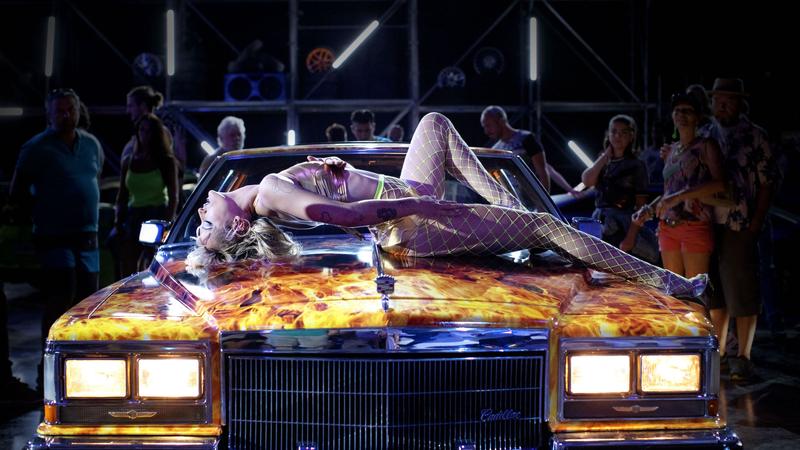
 Titane, written and directed by Julia Ducournau. Starring Agathe Rousselle and Vincent Lindon. France/Belgium, 108 minutes, III. Opened Apr 21. (PHOTO PROVIDED TO CHINA DAILY)
French writer-director Julia Ducournau has certainly developed a distinct style over an emerging filmography that spans just two feature films.
To say that her second film, 2021 Palme d’Or winner Titane, bears echoes of body horror master David Cronenberg and the mechanical mayhem of Shinya Tsukamoto’s cult classic Tetsuo: The Iron Man is entirely fair. But what makes Titane more than just a trippy, car fetish “romance” — and really what makes it of a piece with Raw, Ducournau’s 2016 debut — is the acutely observed and wholly human mechanical mayhem at the heart of her work. Describing Titane as divisive would be an understatement. You either fully get on board with the demented clash of sex, violence, loneliness and family bonds, or you don’t. It’s that simple.
The story begins with a little girl, Alexia, suffering a traumatic injury in a car crash, and picks up with her years later, now working a lurid motor show as a car model. Alexia (journalist and model Agathe Rousselle in her feature debut) clearly has a car fetish, because following an unwanted advance by a fan and a brutal murder, she has sex with the car she just modeled with. Not in the car. With the car.
As it turns out, Alexia is a homicidal maniac, and after another murder puts her on wanted lists, she cuts off her hair, ditches her singular wardrobe and finds refuge with Vincent (veteran Vincent Lindon, The Measure of a Man), a firefighter desperate to hang on to his youth while still grieving his missing son Adrien. Alexia rebrands herself as Adrien and moves into the firehouse.
 Titane, written and directed by Julia Ducournau. Starring Agathe Rousselle and Vincent Lindon. France/Belgium, 108 minutes, III. Opened Apr 21. (PHOTO PROVIDED TO CHINA DAILY)
That is the tip of a very large thematic iceberg that, despite an utterly ludicrous narrative, is one of the most moving examinations of gender identity, emotional desolation and family to hit screens in many, many years. For all Titane’s garishness, aggressive weirdness and clanging metal, at its core it’s a story about two damaged people searching for some kind of meaningful connection.
Ducournau, so far at least, has demonstrated herself to be a filmmaker with a laser focus on our collective desires, particularly at their most stripped down. In Raw, she explored the depths of our primal appetites through a young woman who develops a taste for human flesh while at veterinary school. She’s doing it again here, this time by exploring the depths of our appetite for love.
Films with the audacity of Titane work because the characters resonate; because we know them. As Vincent, Lindon strikes a perfect balance between machismo and sensitivity in how he processes “Adrien” returning, and you can almost see that Vincent knows the truth and simply doesn’t care. The fantasy is preferable to the agony of the probable fate of his missing child. But Lindon’s heartbreaking turn would have zero traction without Rousselle’s layered, ferocious, androgynous and, despite her killer status, vulnerable portrayal to push against. She demands you acknowledge Alexia’s demented humanity, even at her most depraved. It’s an amazing, suitably unhinged performance that keeps us on our toes.
Surprises are hard to come by in movies these days, so for all Ducournau might owe Cronenberg and Tsukamoto concept-wise, she’s on another level emotionally. Where those two directors aimed to transcend humanity physically, Ducournau seems to be looking for it more deeply in its existing form, warts and all.
