

Hong Kong’s galleries continued to exhibit marquee names during the months of pandemic-related restrictions. Madeleine Fitzpatrick visited two such venues, hosting four titans of contemporary art between them, and came away suitably awed.
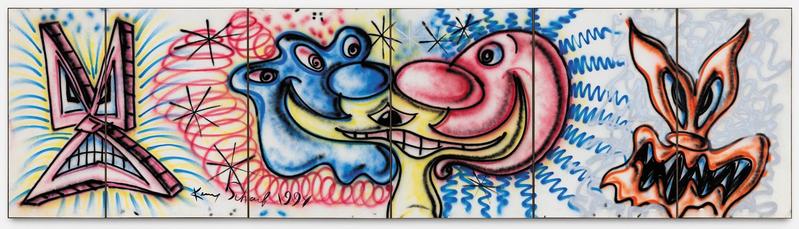 Kenny Scharf’s Untitled (1994) is the magnificent centerpiece in a mood-lit hall dedicated to works by the artist at Opera Gallery Hong Kong. (PHOTO PROVIDED TO CHINA DAILY)
Directors of museums and performance venues breathed a collective sigh of relief yesterday as their premises — closed due to pandemic-related restrictions since Jan 7 — were finally allowed to reopen.
Commercial art galleries have fared better. As Angie Chang Baecker, a lecturer in art history at the University of Hong Kong, notes: “During the fifth wave, the government required museums and artist-run spaces to close, but not commercial art galleries” — meaning the latter became “the primary venues for the public to see art in Hong Kong”.
Operating normally was not an option though. “The restrictions restrained us from holding big events,” says Olivier Demblum, director of Opera Gallery Hong Kong. “Our shows couldn’t open with fancy parties or vernissages.”
While some galleries made exhibitions accessible by appointment, others, like Demblum’s, continued to allow walk-ins.
 William Kentridge’s World War II-themed triptych Weigh All Tears and Cursive, a collection of 40 small sculptures the artist calls “glyphs”, are on show at Hauser & Wirth. (PHOTO PROVIDED TO CHINA DAILY)
Opera was founded in Paris in 1994, and 10 years later became one of the first international galleries to expand its footprint to Hong Kong. Demblum says its network of loyal collectors has cushioned the impact of COVID-19.
“When the pandemic made it complicated for our friends from abroad to visit, we deployed online viewing rooms,” he adds. “Business is only marginally impacted by the pandemic.”
The gallery even doubled down on its commitment to Hong Kong, moving to a spectacular new location at 9 Queen’s Road last fall. The three-floor, 5,500-square-foot space is currently showing Basquiat, Haring, Scharf, featuring nearly 40 works by the “three musketeers” of 1980s New York’s East Village art scene: Jean-Michel Basquiat (1960-88), Keith Haring (1958-90) and Kenny Scharf (b. 1958). According to Opera Gallery, it’s the first time the three icons have been shown together in Hong Kong.
 William Kentridge’s World War II-themed triptych Weigh All Tears and Cursive, a collection of 40 small sculptures the artist calls “glyphs”, are on show at Hauser & Wirth. (PHOTO PROVIDED TO CHINA DAILY)
Signature graffiti
The first substantial work to greet visitors to the gallery is a vibrant and massive work (at nearly five meters across) from Haring: Untitled (June 10, 1984). It’s the kind of piece that invites musings on cults and extraterrestrials, and the stylized figures — outlined in black with curved lines indicating gestural movement — are signature Haring.
Originally from Pennsylvania, Haring moved to New York after dropping out of the Ivy School of Professional Art in Pittsburgh. Noticing empty, black advertising spaces in the subway that he realized were “the perfect place to draw”, the artist began leaving white-chalk graffiti in stations, earning him recognition and, soon after, commissions. He would produce more than 50 public artworks (many voluntarily) between 1982 and 1989, his colorful outdoor murals addressing social issues from the AIDS crisis to drugs to inequality. “Sexuality, death and war are central themes in Haring’s oeuvre,” notes Demblum.
In 1986, Haring opened his first Pop Shop in Manhattan, with the aim of making art accessible to everyone, regardless of their spending power. The shop sold T-shirts and novelty items featuring imagery by himself as well as contemporaries including Scharf and Basquiat.
 Highlight pieces from the Opera Gallery Hong Kong exhibition include Keith Haring’s Untitled (June 10, 1984) and Jean-Michel Basquiat’s Back of the Neck, featuring the artist’s signature gold crown motif. (PHOTO PROVIDED TO CHINA DAILY)
Visceral reactions
In the gallery’s basement, visitors can find Basquiat’s arresting Back of the Neck (1983). On the right-hand side of the editioned silkscreen painting, a dismembered arm and section of torso display the anatomical details of muscle and sinew.
The seeds of this piece — and the 18-part Anatomy series, on the ground floor — were planted after the artist was hit by a car at the age of seven, resulting in a broken arm and severe internal injuries. Laid up in hospital for a month after having his spleen removed, young Basquiat was given Gray’s Anatomy by his mother to help pass the time. He was soon poring over the book’s anatomical drawings — an experience that would profoundly impact his oeuvre.
Entirely self-taught, Basquiat first made a name for himself as part of the graffiti duo SAMO. His ascent to artistic superstardom was vertiginous: between the late ’70s and early ’80s he went from homeless to hot commodity in his native New York. Via a visual lexicon of personally and historically resonant iconography, he explored social issues as well as his African and Latin heritage. Observes Demblum: “Basquiat’s art focuses on dichotomies such as wealth versus poverty, integration versus segregation, and inner versus outer experience.”
 Highlight pieces from the Opera Gallery Hong Kong exhibition include Keith Haring’s Untitled (June 10, 1984) and Jean-Michel Basquiat’s Back of the Neck, featuring the artist’s signature gold crown motif. (PHOTO PROVIDED TO CHINA DAILY)
Mixed emotions
Elsewhere in the basement are several works of pop surrealism by Scharf. The largest — at nearly seven meters across — and most striking is Untitled (1994). The artist, who grew up in Los Angeles and earned a degree in fine arts from the School of Visual Arts in New York, has said the images in his works come from the unconscious and are therefore surrealist. His unconscious, though, “is filled with pop imagery” — a result of Scharf absorbing the aesthetics of pop art during his formative years.
The 1980s saw the artist creating immersive installations in rundown spaces, often using found objects including trash. “Scharf was born and raised in an era when consumerism was at its height,” explains Demblum. “He has become increasingly environmentally conscious, and strives to raise public awareness of the detrimental impacts of waste and the importance of sustainability via his oeuvre.”
 The film Sibyl sees William Kentridge’s animated drawings paired with a haunting soundtrack. (PHOTO PROVIDED TO CHINA DAILY)
Past and future
Meanwhile, Hauser & Wirth is displaying Weigh All Tears, the first solo exhibition in Hong Kong of South African artist William Kentridge (b. 1955), with support from Cape Town’s Goodman Gallery.
Entering the exhibition space, one’s eye is drawn to large, black bronze sculptures. The figures blend familiarity with mystery: some are plants, some animals, while others appear as man-made objects transformed into unrecognizable, unnameable things. Larger iterations of objects from the Cursive (2020) series of 40 small bronzes, these “glyphs” began life as ink drawings and paper cutouts.
The titular Weigh All Tears (2021), a six-meter-wide triptych, shows silhouetted figures against a collage of maps of Africa and archival documents. The figures are based on images of workers traveling from Southern to Northern Italy after the World War II. Four separate tapestries (2020-21) use mid-20th-century maps of China’s Hebei province as the backdrop. The iconography references Kentridge’s preoccupation with parsing the historical record as well as a broader theme of his oeuvre: migration.
The film Sibyl (2020) unites many of the exhibition’s figures, symbols and phrases in a flickering animation flipbook, paired with a haunting choral soundtrack. Inspired by the myth of the Cumaean Sibyl, a prophetess who wrote people’s fates on oak leaves — though these, inevitably, would blow in the wind and become muddled — the film’s turning pages and changing images are a reflection on destiny and mortality.
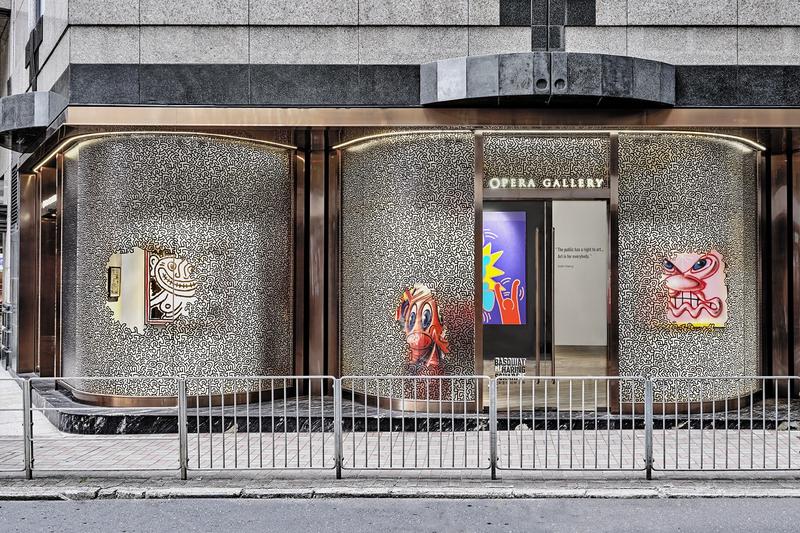 Art lovers passing by Opera Gallery can enjoy some of the works by Haring and Scharf on display. (PHOTO PROVIDED TO CHINA DAILY)
As for reading the oak leaves on contemporary titans showing in the city, “The presence of gallery shows with works by Kentridge, Basquiat, Haring and Scharf speaks to the development of Hong Kong’s art market over the last two decades, and its integration with other centers of the global art trade,” says HKU’s Baecker, describing the works of all four artists as “a blue-chip investment”.
“For Hong Kong to be hosting these shows demonstrates that — in spite of the tumult of the last few years — it’s business as usual for much of the art world, in Hong Kong as elsewhere.”
If you go
Basquiat, Haring, Scharf
Date: Through May 14
Venue: Opera Gallery, Shop G08-09, The Galleria, 9 Queen’s Road Central, Central
William Kentridge: Weigh All Tears
Date: Through May 29
Venue: Hauser & Wirth, 15-16/F, H Queen’s, 80 Queen’s Road Central, Central
hauserwirth.com/locations/10075-hauser-wirth-hong-kong/#exhibitions
Contact the writer at madeleine@chinadailyhk.com
