

 People wearing protective masks to help curb the spread of the coronavirus walk along a pedestrian crossing, Jan 18, 2022, in Tokyo. (EUGENE HOSHIKO /AP)
BANDAR SERI BEGAWAN / BANGKOK / JERUSALEM / KATHMANDU / SYDNEY / TASHKENT / TOKYO / VIENTIANE - Japan reported 32,197 daily COVID-19 cases across the country on Tuesday, exceeding the previous record of 25,992 daily cases in August last year and logging a new all-time high, according to an NHK tally based on data from local governments.
The Tokyo metropolitan government confirmed 5,185 new infection cases, the first time to top 5,000 in nearly five months since Aug 21, 2021
The Tokyo metropolitan government confirmed 5,185 new infection cases, the first time to top 5,000 in nearly five months since Aug 21, 2021. The number rose more than five times from 962 on last Tuesday, recording the biggest count on Tuesdays ever.
The latest average of daily infection cases in seven-day period stood at 3,858.6 per day, quadrupling from the previous week, according to the metropolitan government.
Nearly half of the daily cases, or 2,452 people, have finished two shots of the COVID-19 vaccine.
The number of severely ill COVID-19 patients under the metropolitan government's criteria rose by two to seven from the previous day as of 6:00 pm local time.
The capital's government reported no new death cases related to the COVID-19.
Western Osaka prefecture reported 5,396 new cases on Tuesday, surpassing the count of 3,760 cases on Jan 16 and logging a new record.
The government is reportedly considering declaring a quasi-state of emergency for Tokyo and three nearby prefectures of Saitama, Chiba, and Kanagawa, with Chief Cabinet Secretary Hirokazu Matsuno saying on Monday that new infections are spreading at an "unprecedented rate."
"A number of prefectures have requested the measure, and we would like to decide on them speedily," Japanese Prime Minister Fumio Kishida said Tuesday.
Earlier this week, the governors of Tokyo and other 12 prefectures requested to be put under a quasi-state of emergency. The 12 prefectures included Saitama, Chiba, Kanagawa and Aichi.
Hiroshima, Yamaguchi and Okinawa have been under a quasi-state of emergency since earlier this month.
 Health care workers administer COVID-19 tests at a drive-through clinic in Sydney on Dec 31, 2021. (BIANCA DE MARCHI / AAP IMAGE VIA AP)
Australia
Australia on Tuesday suffered its deadliest day of the pandemic as a fast-moving Omicron outbreak continued to push up hospitalization rates to record levels, even as daily infections eased slightly.
Australia is dealing with its worst COVID-19 outbreak, fueled by the Omicron variant of the coronavirus that has put more people in hospitals and intensive care than at any time during the pandemic.
Amid rising hospitalizations, Victoria on Tuesday declared a "code brown" in hospitals, typically reserved for shorter-term emergencies, that would give hospitals the power to cancel non-urgent health services and cancel staff leave
A total of 74 deaths were registered by late morning between New South Wales, Victoria and Queensland, Australia's three most populous states, exceeding the previous national high of 57 last Thursday, official data showed.
Amid rising hospitalizations, Victoria on Tuesday declared a "code brown" in hospitals, typically reserved for shorter-term emergencies, that would give hospitals the power to cancel non-urgent health services and cancel staff leave.
Authorities have said unvaccinated younger people form a "significant number" of the country's hospital admissions.
Even as states look to avoid lockdowns and keep businesses open, Australian consumer confidence took a battering last week, an ANZ survey out on Tuesday showed, as the Omicron surge triggered self-imposed lockdowns and stifled spending.
Just over 67,000 new infections were reported in New South Wales, Victoria, Queensland and Tasmania, down from a national high of 150,000 last Thursday. Other states are due to report later.
Australia has reported about 1.6 million infections since the pandemic began, of which around 1.3 million were in the last two weeks. Total deaths stood at 2,757.
READ MORE: Australia's virus cases hit record high amid Omicron outbreak
Brunei
Brunei reported 20 new confirmed cases of COVID-19 on Monday, bringing the total tally to 15,901.
According to Brunei's Ministry of Health, the newly recorded cases included 15 local infections and five imported cases.
As of Jan 16, 94.7 percent of Brunei's population have received at least one dose of the COVID-19 vaccine, while 93.8 percent have completed their vaccination schedule of two doses and 33.1 percent have received a third dose.
A total of 347 active cases are currently being treated and monitored in Brunei, and 102 deaths from COVID-19 have been recorded in the Southeast Asian country.
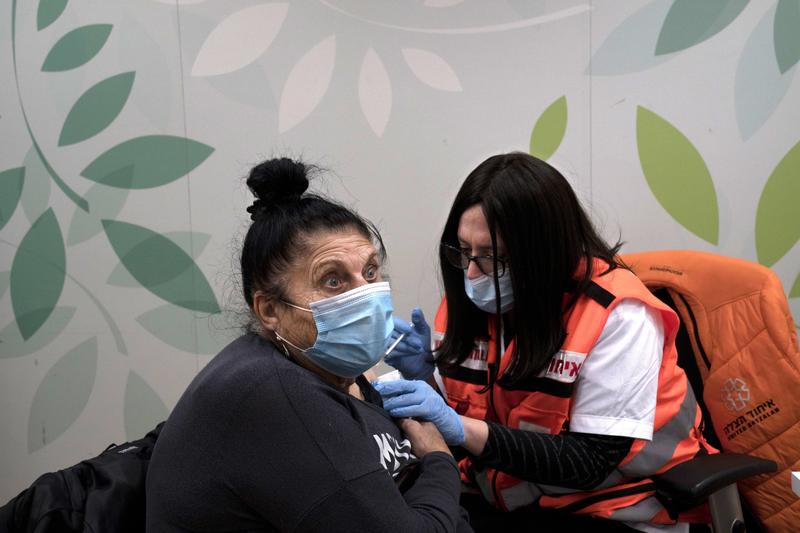 Esther Pamensky, a volunteer with the women's unit of United Hatzalah emergency service, administers a fourth dose of the COVID-19 vaccine to a woman at Clalit Health Services in Mevaseret Zion, Jerusalem, Jan 11, 2022. (MAYA ALLERUZZO / AP)
Israel
Israel's Health Ministry said on Monday it would shorten the mandatory isolation period for those who test positive for COVID-19 to five days from seven days, following an initial cut last week, provided they are asymptomatic.
Until last week, the isolation period was 10 days.
The latest decision, which takes effect on Wednesday, brings Israel in line with recommendations in the United States.
A negative home antigen test is also required before ending isolation, the ministry said.
Prime Minister Naftali Bennett said a spike in infections due to the Omicron variant of the coronavirus and the amount of people in isolation has become a burden on the Israeli economy.
The country's pandemic-response coordinator, Salman Zarka, said the health ministry has found that people are at their most contagious during the first three days after infection.
A fourth shot of COVID-19 vaccine boosts antibodies to even higher levels than the third jab but it is not enough to prevent Omicron infections, according to a preliminary study in Israel.
Israel's Sheba Medical Center has given second booster shots in a trial among its staff and is studying the effect of the Pfizer booster in 154 people after two weeks and the Moderna booster in 120 people after one week, said Gili Regev-Yochay, director of the Infectious Diseases Unit.
These were compared to a control group that did not receive the fourth shot. Those in the Moderna group had previously received three shots of Pfizer's vaccine, the hospital said.
The vaccines led to an increase in the number of antibodies "even a little bit higher than what we had after the third dose", said Regev-Yochay.
The findings, which the hospital said were the first of its kind in the world, were preliminary and not yet published.
Laos
Lao health authorities are distributing COVID-19 vaccines to target groups in all provinces in a bid to vaccinate as many people as possible and boost immunity countrywide.
Local daily Vientiane Times on Tuesday quoted Head of the Vaccine Preventable Disease Division under the Ministry of Health, Kongxay Phounphenghack, as saying that the division is aiming to provide vaccinations quickly and efficiently, hoping to make steady progress in protecting everyone against COVID-19.
"We have enough vaccines to meet the needs of communities throughout the country. Each type of vaccine has a set expiry date and must be used before that time, so we want to ensure that our stocks are used quickly and none goes to waste," Kongxay said.
The vaccination program is running smoothly because there are enough staff to support the rollout, and it is hoped the goal to vaccinate 80 percent of the population by the end of 2022 will be achieved, he said.The priority groups for vaccination are children aged 12-17, people aged 60 and over, people with underlying health conditions, and pregnant women.
So far, 63.37 percent of the eligible population had received the first dose of a COVID-19 vaccine, while 51.96 percent had been given two doses, according to the National Taskforce Committee for COVID-19 Prevention and Control.
 Workers wear face masks and practice social distancing while they wait to be tested for the coronavirus at Khaosan road, Jan 6, 2022, in Bangkok. (VICHAN POTI / AP)
Thailand
Thailand is considering bringing back a quarantine waiver for vaccinated visitors, its health minister said on Monday, as part of a proposed easing of some COVID-19 measures later this week.
Thailand reopened to vaccinated foreign visitors in November to help a vital tourism industry that collapsed during nearly 18 months of strict entry policies. It saw about 200,000 arrivals last year, compared to nearly 40 million in 2019.
The 'Test and Go' policy, which allows visitors to skip the mandatory quarantine if they test negative on arrival, was suspended late in December over concerns about the spread of the Omicron coronavirus variant.
"We will propose measures that can be done safely and are medically sound," Health Minister Anutin Charnvirakul told Reuters.
"If approved it can start by Feb 1," he said of the quarantine waiver.
Thailand recorded 6,929 new COVID-19 infections and 13 deaths on Monday. More than 2.3 million people have been infected overall, with 22,000 deaths.
Nepal
Nepal began giving COVID-19 vaccine booster shots on Monday as coronavirus infections surged due to the spread of the Omicron variant, officials said.
Daily cases jumped by 4,961 on Sunday, the biggest 24-hour increase in more than six months, taking total infections to 955,206, government data showed. COVID-19-related deaths stand at 11,620, the data showed.
The booster shots will be restricted to frontline workers for one week from Monday, the Health Ministry said, after which they'll be offered to people 60 and older.
“The booster shots will be given to those people who have completed six months after getting a second vaccine dose,” the government said in a statement.
The Nepal government has banned large public gatherings and closed schools and colleges until the end of January to curb the rate of infection.
Authorities have also made it compulsory for people to produce proof of full vaccination to use public services from this week, prompting large queues at vaccine centers.
Uzbekistan
Uzbekistan registered 1,037 daily COVID-19 infections on Sunday, the highest number since the start of the pandemic, the Uzbek Health Ministry said Monday.
The previous daily record of 974 was recorded in August 2021. The country has tightened pandemic restrictions as the first case of the Omicron variant was reported early this month.
Uzbekistan has so far registered 206,122 COVID-19 cases and 1,518 related deaths.
