

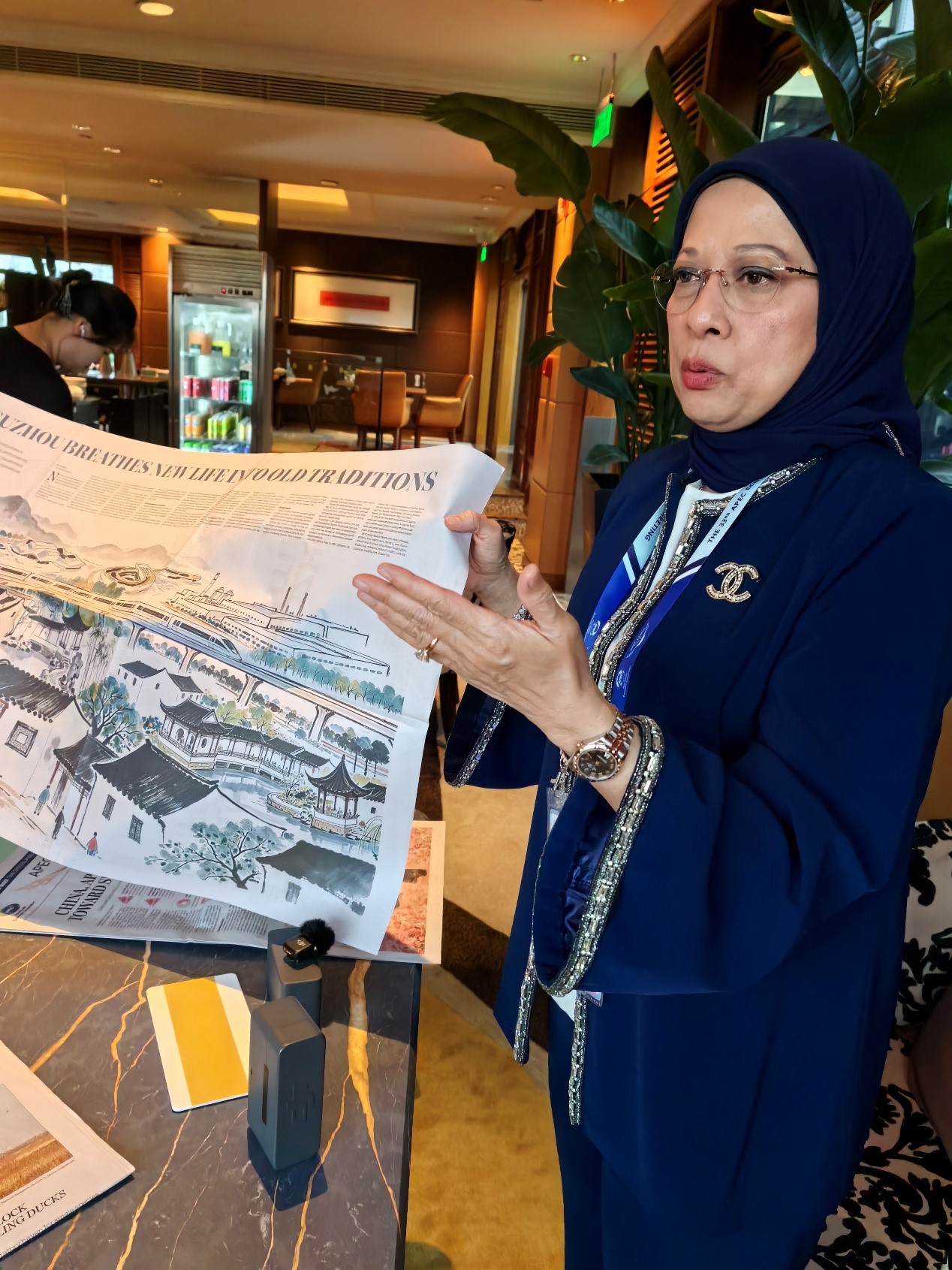
China’s development, with rapid technological advancement and urban transformation, has laid out practical pathways for deeper bilateral cooperation between Malaysia and China, a Malaysian member of APEC Business Advisory Council (ABAC) said.
During an interview with China Daily, Hazimah Zainuddin, senior board member of the Malaysia External Trade Development Corp, said China serves as a valuable development reference for Malaysia.
The country has made remarkable strides in urban development, waste management and manufacturing. All these areas, she said, offer experience for Malaysia to draw upon.
She identified technology transfer as a key part of bilateral ties. China could share its expertise in transportation and robotics technologies with Malaysia. At the same time, trade should flow in both directions, creating reciprocal commercial benefits for both sides, she said.
“China is important to us. I like to think about how China, from what it was, has developed into a different nation — be it technology, be it agriculture, or be it environment,” said Hazimah, who is also founder and group executive chairman of the Malaysian company Hyrax Oil.
“China is never an enemy, and should not be an enemy to anyone. It should be a partner in every success the world achieves.”
ALSO READ: Vice-Premier He addresses opening of 4th APEC Business Advisory Council meeting
Trade between China and Malaysia has been growing steadily over the past years. China has remained Malaysia’s largest trading partner for 17 consecutive years. Bilateral trade volume hit $191.66 billion in 2025, growing 12 percent year-on-year, according to the China Customs.
Chinese investments in the Southeast Asian country have also been rising. A report from China Enterprises Chamber of Commerce in Malaysia shows that Chinese enterprises invested in a total of 497 manufacturing projects in Malaysia from 1980 to 2023, with a total investment of 74.2 billion ringgit ($18.04 billion), creating more than 82,000 jobs. As of 2024, China’s accumulated investment in Malaysia had surpassed $19 billion.
As the incoming chair of ABAC’s Sustainable and Inclusive Working Group for 2027, Hazimah outlined two core priorities she will lead and advance.
The primary focus will be on the care economy, where she will seek solutions to address the heavy caregiving burden that forces many Malaysian women to step away from their careers and businesses, and causes substantial economic losses for the country.
“In Malaysia, we lost about 365 million ringgit in output last year due to caregiving issues. Women have to sacrifice their jobs and businesses for sick or aging parents, children and so on,” she said.
READ MORE: APEC Business Advisory Council 2026 meetings produce 14 outcome documents
Hazimah also noted that she will push for greater gender parity in business representation, aiming for a 50 50 balance between men and women.
The other area of focus will be on the efforts to support young entrepreneurs to build resilient businesses that can be sustained for future generations, she added.
Contact the writer at sally@chinadailyhk.com
