

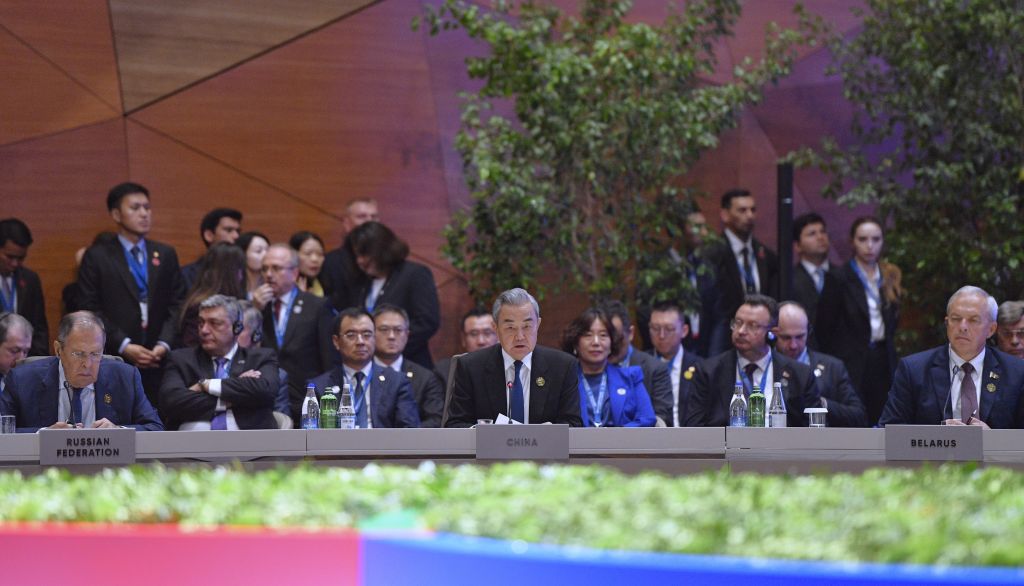
BAKU — Chinese Foreign Minister Wang Yi attended the Seventh Summit of the Conference on Interaction and Confidence Building Measures in Asia (CICA) here on Thursday and put forward four proposals to advance cooperation among CICA member states.
First, jointly safeguard peace and stability. Asia does not need a Cold War mentality and does not welcome bloc confrontation. Asia's problems should ultimately be addressed by the people of Asia through solidarity and cooperation, and Asia's security should be ensured by upholding the vision of common, comprehensive, cooperative and sustainable security, said Wang, also a member of the Political Bureau of the Communist Party of China Central Committee.
The situation in the Middle East continues to evolve in a complex manner, profoundly affecting the world, Wang said. China encourages the United States and Iran to return to the political and diplomatic track to resolve their disputes, and calls on the parties involved in the Yemen issue to exercise restraint, he said.
ALSO READ: China confident of fruitful APEC 'China Year' with support from Russia, other parties
The sovereignty and security of countries in the region should be respected, the stability of international industrial and supply chains should be ensured, and important shipping routes such as the Strait of Hormuz and the Red Sea should remain open, Wang said, adding that the Palestinian question should be brought back onto the right track of the two-state solution as soon as possible.
Noting that Afghanistan is an integral part of Asia's security, Wang said China hopes to strengthen regional coordination on the Afghan issue and provide humanitarian and development assistance to the Afghan people. The Afghan government should take concrete measures to eliminate violent terrorist forces operating on its territory so that Afghanistan can achieve lasting peace and stability at an early date, Wang said.
Second, jointly promote prosperity and revitalization. Development is the master key to solving all problems. Efforts should be made to better align high-quality Belt and Road cooperation with the development initiatives of various countries, safeguard an open environment for cooperation, advance trade and investment liberalization and facilitation, ensure the stable and efficient operation of international transport corridors, and strengthen supply security for critical raw materials, energy resources and food, so that Asian countries can work together to accelerate their progress toward modernization, Wang said.
READ MORE: IMF sees Asia’s growth slowing despite AI-fueled resilience
Third, jointly promote exchanges and mutual learning among civilizations. Asia is the continent with the greatest diversity of civilizations. Efforts should be made to firmly promote the Asian values of peace, cooperation, openness and inclusiveness, respect countries' independent choices of development paths and governance models, deepen exchanges and cooperation in culture, tourism and health, as well as among women's and youth groups, media organizations and think tanks, and promote people-to-people exchanges and closer bonds between peoples, so that diverse civilizations can learn from one another and flourish together, Wang said.
Fourth, jointly improve global governance. Efforts should be made to reinvigorate the authority and role of the United Nations, uphold the basic norms governing international relations established by the UN Charter, strengthen capacities in digital governance, disaster prevention and mitigation, and public health, and jointly build a more efficient, inclusive and resilient governance system in Asia, Wang said.
