

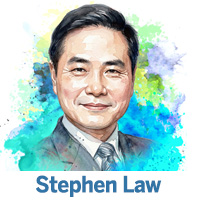
Stephen Law says the long-awaited blueprint is a solid foundation for Hong Kong’s long-term prosperity, stability and shared future
 Hong Kong’s first five-year plan for economic and social development, covering 2026 to 2030, is a landmark in the successful practice of the “one country, two systems” policy. It is the first comprehensive, top-level design for Hong Kong’s economic and social development since the city’s return to the motherland in 1997. It charts a clear course for Hong Kong to accelerate its transition from stability to prosperity, better integrate into and serve the country’s overall development, and achieve high-quality development.
The plan stands firmly on the foundation of “one country” while making good use of the distinctive advantages of “two systems”. It fully aligns Hong Kong’s development with the national 15th Five-Year Plan (2026-30), gives full play to the city’s unique advantages, upholds the combination of an effective market and a proactive government, and uses reform and innovation to address deep-seated economic and livelihood issues. In doing so, it strengthens social consensus, improves governance effectiveness, builds new development momentum, and better safeguards the well-being of Hong Kong residents.
The plan is therefore not simply a document setting out aspirations. Together with the 2026 Policy Address, it establishes a practical system for action: medium-term strategic direction, annual policy implementation, budgetary support, clear responsibilities, dynamic monitoring, midterm assessment, and final evaluation. This is how Hong Kong can translate the plan’s “vision map” into a tangible “real scene” of development, so that the public can see and share the results of progress.
Finance at the core
Economic development remains the foundation for enhancing people’s well-being, sustaining public services, and strengthening Hong Kong’s international competitiveness. The plan appropriately places the consolidation and enhancement of Hong Kong’s international financial-center status at the center of its growth strategy while supporting the coordinated development of international trade, shipping and aviation, innovation and technology, and the international high-caliber talent hub.
Hong Kong’s financial system is one of the country’s most important international assets. Its common law framework, free flow of capital, freely convertible currency, globally connected financial institutions, deep capital markets, sound regulatory system and internationally recognized professional-services sector give the city an irreplaceable role in connecting the Chinese mainland with the rest of the world.
The plan sets out a coherent agenda for strengthening this role: deepening financial connectivity, expanding offshore renminbi business, developing corporate treasury centers, enhancing the capital market, building a commodities-trading ecosystem, and promoting green and sustainable finance. These are not isolated initiatives. Together, they will reinforce Hong Kong’s capacity to allocate capital efficiently, manage risk professionally and serve the country’s high-level opening-up.
From my experience in private equity, corporate finance and capital markets, businesses do not choose a city merely on the basis of a single tax concession or a short-term market cycle. They choose a market because it offers trusted rules, transparent regulation, professional expertise, access to capital, sophisticated risk-management capability, and a reliable base for international growth. Hong Kong’s strength is precisely such a complete and internationally connected ecosystem.
The continued development of the offshore RMB market deserves particular attention. Hong Kong should further enlarge RMB liquidity, expand the supply of investment and risk-management products, and facilitate the use of RMB in cross-border trade, investment and financing. This will reinforce Hong Kong’s unique function in the orderly internationalization of the RMB and in supporting the country’s financial opening-up.
Similarly, the further expansion of Stock Connect, Bond Connect, Wealth Management Connect and Private Equity Connect should focus not only on the number of channels but on the depth, convenience and quality of the markets they connect. Hong Kong should continue to be the premier international platform through which quality mainland and overseas enterprises raise funds, while also enabling global investors to participate in China-related opportunities through transparent and well-regulated arrangements.
The plan’s proposal to use gold as an entry point for building a commodities-trading ecosystem is another important strategic step. Hong Kong should develop a complete value chain encompassing trading, financing, storage, custody, clearing, settlement, insurance, valuation, hedging, compliance and dispute resolution. Such an ecosystem will strengthen Hong Kong’s international financial-center function and enable it to contribute more effectively to the country’s needs in strategic commodities, energy transition, and global supply-chain resilience.
Serving national development
Hong Kong’s role as a two-way platform is central to the plan. The city should assist overseas enterprises in entering the mainland market while supporting mainland enterprises in using Hong Kong as a springboard to expand abroad. This is not simply a commercial opportunity. It is a concrete way for Hong Kong to serve the country’s overall development and support high-quality Belt and Road Initiative cooperation.
The plan’s proposal for a comprehensive, two-way service platform is therefore highly significant. It links finance, law and dispute resolution, accountancy, logistics, insurance, testing and certification, creating an ecosystem that can support enterprises through every stage of overseas expansion. A company “going global” needs more than capital. It needs credible financial reporting, cross-border tax capability, corporate-governance support, treasury and foreign-exchange management, intellectual-property protection, environmental, social, and governance (ESG)expertise, supply-chain advice, and risk-management solutions.
As president of the Hong Kong Institute of Certified Public Accountants (HKICPA), I welcome the strong directional alignment between the SAR government’s plan and many recommendations set out in the institute’s earlier submission. The institute’s comparison analysis found that many of its policy directions have at least partial correspondence with the final plan, particularly in corporate treasury centers, enterprise “going global” services, offshore RMB, commodities trading, green finance, CEPA (Closer Economic Partnership Arrangement) market access, artificial intelligence, and high-end professional services in the Northern Metropolis. This should not be understood as a claim that individual HKICPA proposals have been formally adopted. It demonstrates, rather, a shared understanding between the government and the professional community of the direction Hong Kong must take.
The profession will actively turn this common direction into practical support. Accountants are not merely compliance providers. They are an important part of the trust infrastructure that sustains market confidence, facilitates capital flows and supports enterprise development. Financial reporting, assurance, valuation, tax, governance, sustainability disclosure, due diligence and risk management are all essential if Hong Kong is to build high-quality markets and help enterprises succeed internationally.
Corporate treasury centers are a clear example. The government’s intention to improve relevant tax concessions and enhance Hong Kong’s attractiveness for mainland and overseas enterprises setting up treasury functions is strategically sound. Hong Kong should deliver a clear, predictable and internationally competitive operating environment, including well-designed advance-approval and tax-certainty arrangements where appropriate. At the same time, it should develop a deeper pool of treasury, accounting, tax, foreign-exchange and risk-management professionals to support companies’ global capital allocation and risk-control needs.
Hong Kong should also make full use of its international professional strengths in high-quality Belt and Road Initiative cooperation. Through disciplined project finance, credible due diligence, robust financial controls, transparent sustainability reporting, carbon-market expertise and professional dispute resolution, Hong Kong can help improve project quality, manage risk and mobilize long-term capital. This is where Hong Kong’s internationally recognized standards and professional services can make a distinctive contribution to the country’s global economic engagement.
Greater Bay Area delivery platform
The Guangdong-Hong Kong-Macao Greater Bay Area is where Hong Kong can most directly turn national planning into local results. The next stage of Greater Bay Area development should build on physical links, but must go further. The real objective is to deepen institutional connectivity, market connectivity, professional connectivity and people-to-people connectivity.
The Northern Metropolis is particularly important in this regard. The plan positions Hung Shui Kiu/Ha Tsuen and Lau Fau Shan as a high-end professional-services, modern-logistics, advanced-construction, smart-manufacturing and digital-technology hub. It also envisages stronger synergies with Qianhai and Nanshan. This provides a sound foundation to develop cross-boundary clusters that combine Hong Kong’s professional and international strengths with the innovation, industrial scale and market opportunities of Shenzhen and the wider Greater Bay Area.
The HKICPA has proposed a “Hong Kong Accounting Park” concept. The plan does not formally adopt that title, but it provides meaningful policy space for a high-end professional-services cluster. Such a cluster could integrate accounting, audit, tax, valuation, corporate finance, corporate treasury, sustainability assurance, AI-enabled compliance and professional training. It could be linked to the Northern Metropolis University Town, Qianhai, and Nanshan, making it a practical delivery platform for helping enterprises in the Greater Bay Area and beyond to expand internationally.
The next step is to translate broad commitments into operational arrangements. Hong Kong should work with relevant mainland authorities to identify and resolve remaining practical barriers under CEPA for accounting, audit, tax, valuation and advisory services. Qualification recognition, scope of practice, talent mobility, appropriate data arrangements and cross-boundary regulatory coordination should be advanced in a pragmatic, orderly manner.
The Greater Bay Area can also become a testing ground for new, high-quality development models: cross-border green-finance products, carbon-market cooperation, renminbi liquidity and risk-management tools, intellectual-property valuation and financing, as well as responsible AI applications in financial and professional services. The aim is to enable Hong Kong’s international standards and institutional strengths to complement the mainland’s technology, industrial capacity and vast market.
Development for the people
The plan’s strength is its comprehensiveness. Its goal is not economic growth for its own sake, but development that brings greater opportunity, stability, security and well-being to the people of Hong Kong. It therefore rightly covers education, talent, innovation, housing, family support, eldercare, public services, social inclusion, and the coordinated pursuit of development and security.
Hong Kong’s competitiveness depends on being a city in which people can build their futures with confidence. Young people must have access to education, training and quality jobs. Families need appropriate support and a stable environment in which to raise children. Older adults should be able to age with dignity. More housing supply, strengthened childcare and family support, improved elderly services, safer buildings, stronger resilience against extreme weather, and better public services all contribute to a more cohesive and sustainable Hong Kong.
The emphasis on AI also reflects the need to prepare Hong Kong’s people for the future. As a board member of Cyberport, I see the opportunity to use AI to support productivity, entrepreneurship and public-service improvement. But innovation must go hand in hand with responsible governance. AI systems must be reliable, transparent and secure; professional judgment and accountability must not be displaced by technology.
The development of intellectual-property financing and valuation is another important bridge between innovation and inclusive opportunity. When research outcomes, technology and creative assets can be valued credibly and financed properly, more entrepreneurs and young companies can grow, attract investment and create quality employment. Finance, accountancy, technology and education must therefore work together to transform innovation into real economic and social value.
As a member of the Green Tech Fund Assessment Committee, I also welcome the plan’s attention to green and sustainable finance, international carbon markets, and the transition to a lower-carbon economy. Hong Kong can mobilize capital for the country’s green transformation, but this requires a trusted system of disclosure, assurance, data, verification and professional capability. Strong standards will reduce greenwashing, protect investors, and direct capital toward projects that genuinely improve environmental outcomes.
Culture, community life and social participation are equally important to a city’s long-term vitality. As a board member of the Hong Kong Dance Company and a member of the Agricultural Park Advisory Committee, I recognize that Hong Kong’s appeal is built not only on financial-market indicators but also on cultural dynamism, a caring community, environmental quality, food resilience and a rich quality of life.
The accountancy profession is committed to contributing beyond the marketplace. The HKICPA has supported financial-literacy and anti-scam education for students and people in need, and has established an HKICPA Volunteer Team to work with social-service organizations in supporting community living rooms, older persons, children, grassroots families and ecological conservation. This reflects the plan’s people-centered spirit: growth should be inclusive, and professional knowledge should serve the wider community.
Turning vision into reality
The blueprint has now been drawn. The time has come to press ahead with unity, confidence and resolve, turning the plan’s “vision map” into a visible and tangible reality of development.
That requires the Hong Kong Special Administrative Region government to maintain strong leadership, coordinate across policy bureaus and departments, and ensure that major initiatives have clear responsibilities, timetables and measurable indicators. It also requires the market to respond with enterprise and innovation, and requires business, professional bodies, universities and community organizations to contribute their expertise and energy.
The principle of an effective market working with a proactive government should guide implementation. Government should set clear strategic priorities, build enabling institutions, improve regulatory certainty, remove practical bottlenecks and invest in long-term capabilities. The market should deploy capital, pursue innovation, raise productivity, create jobs and identify opportunities. The professional community should provide the trust, standards, skills and risk-management discipline that make sustainable development possible.
Hong Kong has the institutional strengths, international networks, talent and national support needed to seize this important moment. By remaining firmly rooted in “one country” and fully leveraging the advantages of “two systems”, Hong Kong can better connect the mainland and the rest of the world, contribute more fully to the country’s high-quality development, and accelerate its progress from stability to prosperity.
The HKICPA and the wider professional community stand ready to support this work through standard-setting, talent development, sustainable-finance assurance, AI and risk-governance capability, enterprise “going global” services, and objective performance evaluation. With all sectors of society working together, the plan can become not only a blueprint for the next five years, but a solid foundation for Hong Kong’s long-term prosperity, stability and shared future.
The author is a member of the National Committee of the Chinese People’s Political Consultative Conference, president of the Hong Kong Institute of Certified Public Accountants, and an advisory expert to the Ministry of Finance.
The views do not necessarily reflect those of China Daily.
