

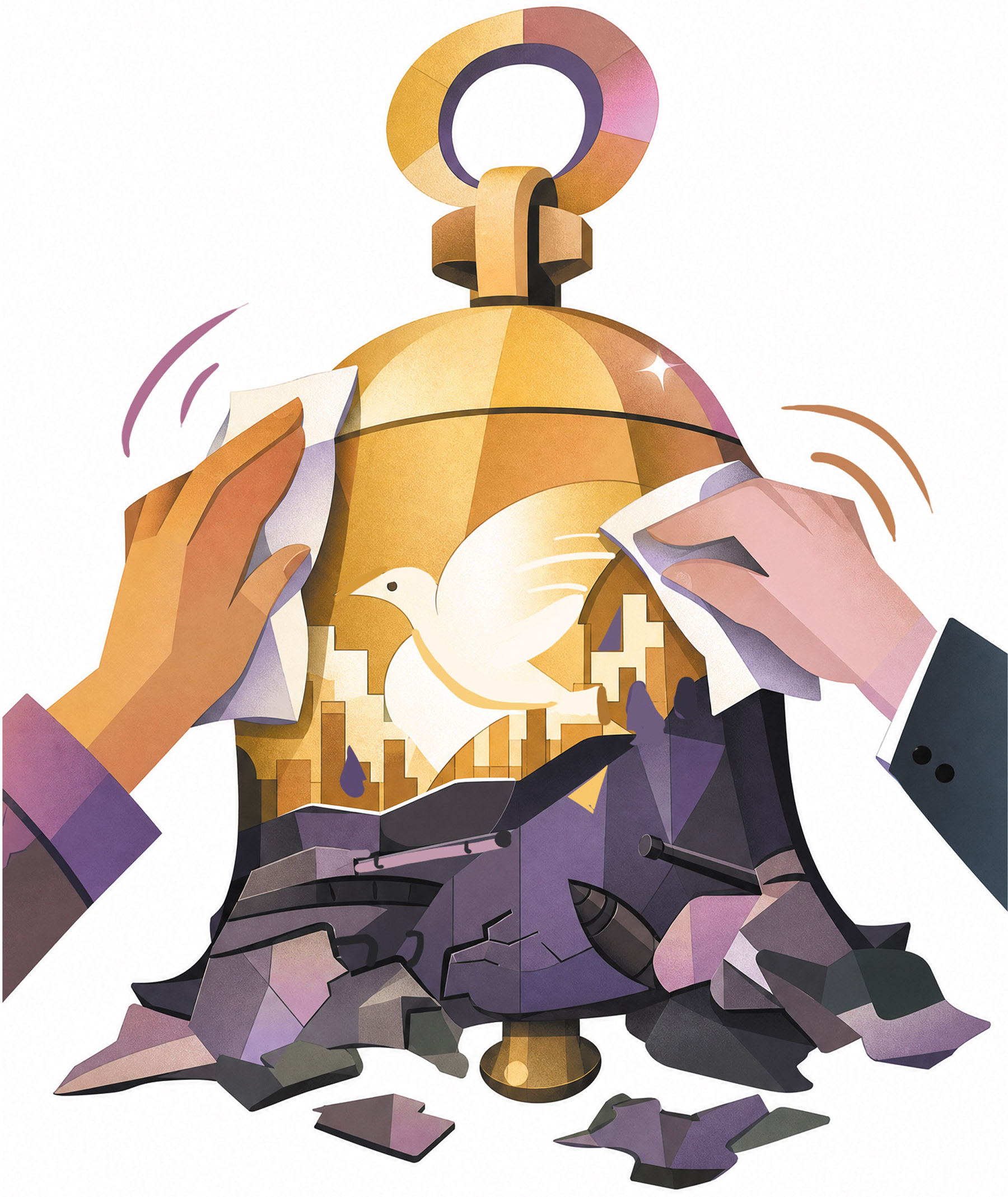
Acorrect understanding of World War II history is necessary so that mistakes of the past are not repeated, and both China and Russia are deeply committed to ensuring this.
In a joint statement issued in May, both countries reaffirmed the commitment to safeguarding the outcomes of the victory embodied in the United Nations Charter and the charters and judgments of the Nuremberg Trials and the Tokyo Trials, and firmly opposing any attempt to deny or distort the history of WWII.
This stance is not just about preserving historical memory. Both China and Russia firmly uphold the UN-centered international system, reminding countries to avoid repeating historical mistakes and advocating for a fair and equitable global security governance system.
The postwar international order has institutionalized international relations and also established global organizations, including the UN, where major issues could be addressed with equal participation of member states.
The interconnected global economy necessitates shared behavioral standards. International law has gained prominence, providing a framework for dispute resolution, as exemplified by the World Trade Organization’s role in shaping international trade rules.
At the same time, the international landscape gradually evolved from Cold War bipolarity to a multipolar structure, driven by the rise of developing countries and initiatives such as South-South cooperation and the Non-Aligned Movement.
Nations increasingly engaged in multilateral cooperation to tackle global challenges.
However, since the end of the Cold War, the postwar international order has faced significant challenges due to shifts in global power dynamics. Some Western countries are still clinging to outdated power politics because they do not want to relinquish their hegemonic positions, and they even distort historical facts.
Meanwhile, Japanese Prime Minister Sanae Takaichi has glorified militarism and refused to acknowledge Japan’s history of aggression during WWII and the atrocities it inflicted on neighboring nations.
These actions blatantly undermine fairness and justice and have drawn widespread condemnation from China, Russia and several Asian countries that suffered Japanese atrocities during the war.
The history of WWII offers crucial lessons for understanding today’s international relations. An accurate view of that history is essential for preventing a relapse into large-scale conflict.
The war was a direct consequence of the lack of fairness and justice in the Versailles-Washington system established after the end of WWI. The Paris Peace Conference became a “looting assembly”, with major powers redrawing their spheres of influence.
The League of Nations was fundamentally flawed.
The global great economic turmoil in 1929-33 created fertile conditions for the rise of fascism in Germany and Italy and militarism in Japan.
Today, the world once again stands at a critical juncture. Transformations unseen in a century are unfolding alongside intensified major-country rivalry and persistent regional conflicts.
Unilateralism and extremism have wantonly trampled on the sovereignty of other countries and blatantly violated the norms of international law centered on the UN Charter.
Resources such as energy, food, and cyber capabilities are weaponized, while concerns over nuclear security have become more acute.
Addressing these challenges requires wisdom.
While the US remains the sole superpower for the foreseeable future, emerging market economies and Global South countries are steadily expanding their influence across various fields.
Developed countries maintain a clear edge in economic and technological competition, prolonging the transition period and resulting in asynchronous shifts in strengths across different areas.
Economically, emerging markets have significantly expanded their share in international trade. However, shifts in security are slower, as the balance of military power, equipment and technology is unlikely to change anytime soon.
Against the backdrop of the prolonged Russia-Ukraine conflict, the spillover of the Middle East crisis, and certain Western countries attempting to maintain their grip on the steering wheel of international affairs, the advance of multipolarity must not devolve into factional confrontations.
In response to hegemonic headwinds, China and Russia have introduced a series of new security concepts within multilateral frameworks such as the UN, the Shanghai Cooperation Organization and BRICS.
For instance, the Global Security Initiative proposed by China seeks to unite the international community in addressing global security challenges and maintaining world peace and stability.
The SCO, advocating the “Shanghai Spirit”, calls for equality among nations, favors partnerships over alliances, and promotes dialogue to resolve disputes. This approach strives to turn the vision of “never again war” into reality.
The author is the director of the Institute of Russian, Eastern European and Central Asian Studies, Chinese Academy of Social Sciences.
The views do not necessarily represent those of China Daily.
