

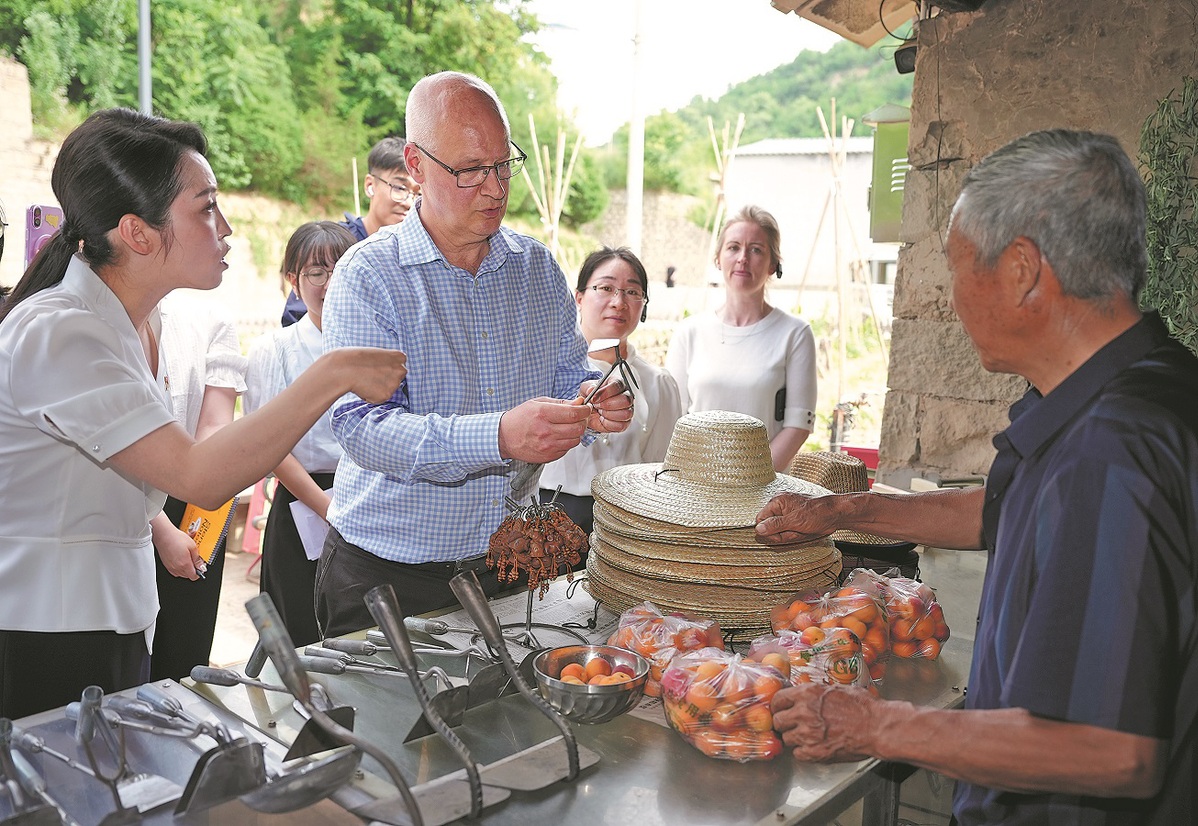
A small handmade iron hoe for tending a garden, a bag of apricots and a pair of cloth shoes were among the souvenirs Peter Wilson bought during a visit to Yan'an in Northwest China's Shaanxi province on Wednesday — the sort of keepsakes any tourist might bring home.
But for Wilson, the United Kingdom's ambassador to China, the visit yielded something less tangible: a closer look at the historical experiences that continue to shape China today.
Standing outside the cave dwelling that once served as Chairman Mao Zedong's residence at the revolutionary site of Yangjialing, Wilson said that he had not expected the Communist Party of China to have grown in strength under such austere conditions.
"Foreigners also need to understand your history. I think it is very important to come here and visit the sites where history unfolded," he said.
Wilson traveled to Yan'an on Wednesday with Lu Kang, vice-minister of the International Department of the CPC Central Committee, after visiting Xi'an, the provincial capital, on Tuesday.
The trip came during Wilson's third posting in China. He took up his current role as ambassador in August last year, more than three decades after first working in the commercial section of the British Embassy in Beijing in the 1990s. He also served as political counselor at the embassy from 2007 to 2010.
"For me, wherever I work, it is very important to understand that country's history in depth, as well as how that country views its own history," Wilson said in fluent Chinese.
"That is why I greatly value this opportunity to visit Shaanxi, Yan'an and Liangjiahe."
Lu said the visit would help the British side gain a more comprehensive, objective and accurate understanding of China and the CPC, while contributing toward greater mutual understanding and the development of China-UK relations.
For Wilson, that process was as much about asking questions and talking with people as it was about visiting historical sites.
At the Yan'an Revolutionary Memorial Hall, he paused before statues depicting international friends and asked about the different roles they played.
At the site of the Seventh National Congress of the CPC, which was held in 1945, he discussed with an interpreter how best to render the Chinese phrase tongxin tongde — "to be of one heart and one mind" — in English.
At the China Executive Leadership Academy, Yan'an, Wilson told reporters that officials from China and the UK should have more opportunities to exchange views and learn from one another.
He expressed hope that officials from both countries would take part in more exchange visits, thus broadening their perspectives and improving their work by learning from each other.
At Liangjiahe, where President Xi Jinping spent seven years — from 1969 to 1975 — living and working alongside local villagers, Wilson asked what time people began and ended their working day decades ago and how village life had changed since then.
According to the organizers, Wilson is the first ambassador from a major Western country to visit Liangjiahe since the 20th National Congress of the CPC in 2022.
At the invitation of local villagers, he sat down with them to eat locally grown apples and drink jujube-bud tea.
Asked what message he would share with other foreign diplomats in China after the trip, Wilson said that he would encourage them to travel more widely and see different parts of the country for themselves.
"We should do that in every country, rather than stay in one place," he said.
Wilson recalled that when he presented his credentials to Xi in January, the Chinese president encouraged the newly appointed ambassadors to travel widely across the country, gain a full and in-depth understanding of the real and multifaceted China, and actively contribute to deepening friendship and cooperation between China and their respective countries.
Wilson said that learning about a country also meant listening to the personal experiences of both its leaders and the ordinary people.
"I really enjoyed talking to people who live in Liangjiahe, hearing how their lives have changed, and also hearing about what life was like before."
As they walked through the village, Shi Chunyang, who worked with Xi when he lived in Liangjiahe, and then went on to become village Party secretary later, told Wilson that even the asphalt road beneath their feet had not existed in those days.
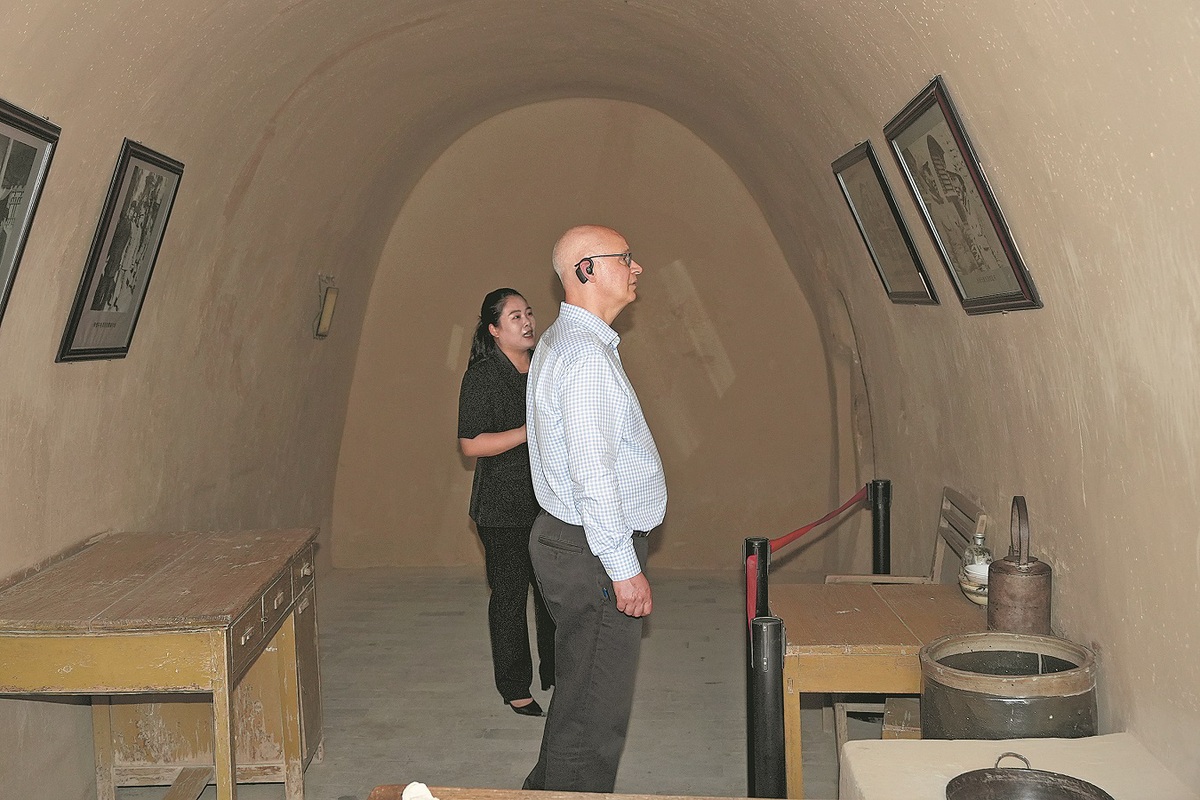
Before a biogas digester was successfully fired up in 1974, lighting the first biogas lamp on the northern Shaanxi plateau, villagers relied on kerosene lamps for illumination, Shi said.
Those stories resonated with Wilson, who has observed China's broader transformation since first visiting Beijing in 1981.
He last visited Xi'an in 2007. Much of the city he saw on this trip, he said, either had not existed or had yet to be developed at the time.
He was similarly struck by the ecological transformation around Yan'an.
"In the old photographs, almost everything was yellow. Now, everything is green," he said, referring to changes in the once largely barren landscape.
Wilson said understanding how China views the history of the CPC can also offer insights into how the country sees its future and shapes its policies.
Britain and China have different political systems, Wilson noted, but that made understanding rather than assumption all the more important.
For diplomats, Wilson said, gaining an in-depth understanding of their host country was essential both to performing their duties and helping their governments understand that country's perspectives.
More exchanges would not necessarily mean that people of Britain and China would see every issue in the same way, he said, but it would allow both sides to see more for themselves, communicate more openly and better understand their common ground as well as their differences.
As permanent members of the United Nations Security Council, Britain and China both bear international responsibilities, Wilson said, noting that understanding how China views its own history also helps explain how it sees the wider world, he added.
To address global challenges ranging from climate change and international conflicts to the governance of artificial intelligence, countries must understand one another's perspectives and work together to shape their shared future, he said.
In colloquial Chinese, he summed up the task more simply:
"Get things done together."
