

China’s new mission to space station includes a female civilian crew member from HKSAR
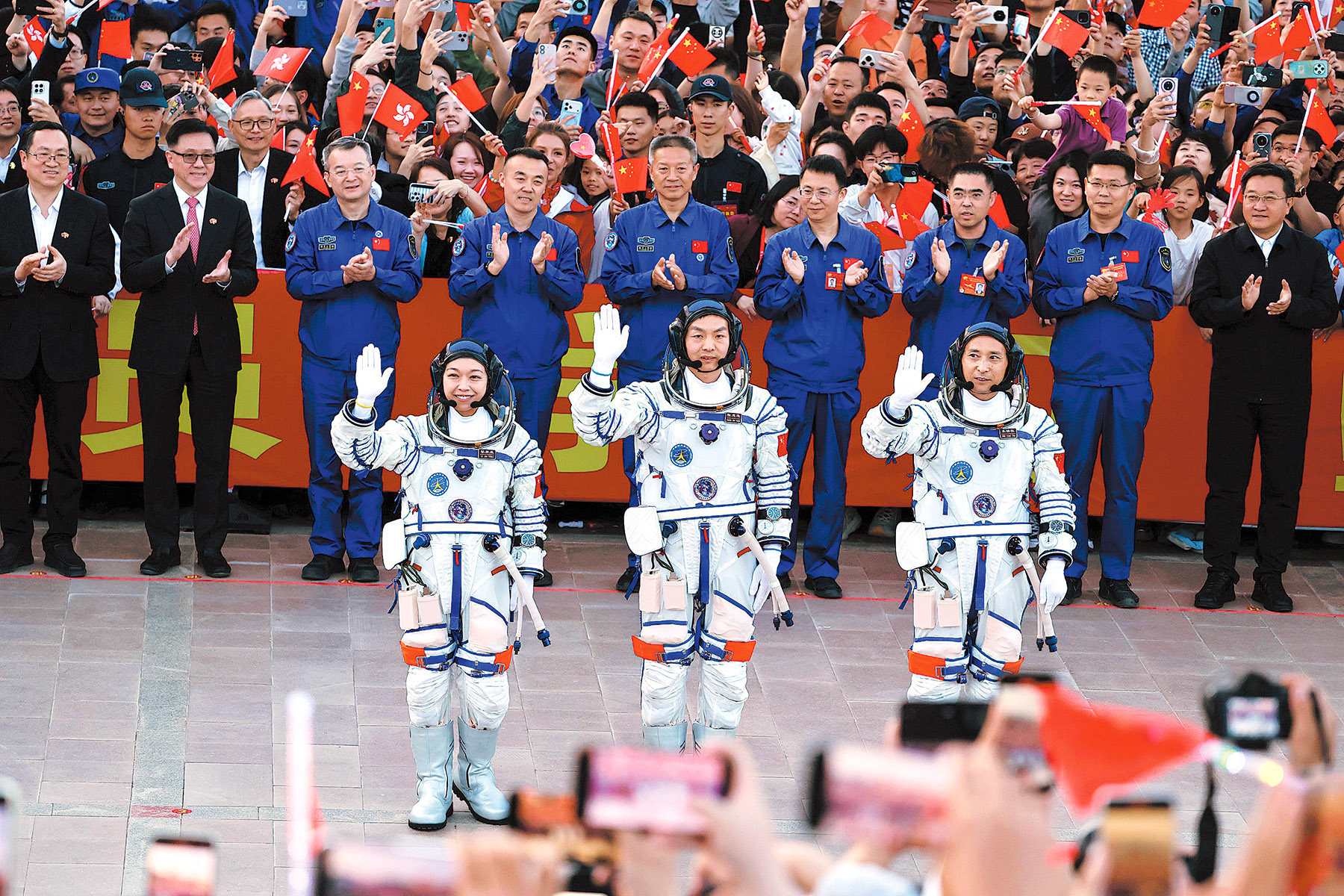
China launched the Shenzhou XXIII manned mission late on May 24 to send three crew members, including the country’s first female civilian astronaut who is also the first orbital traveler from the Hong Kong Special Administrative Region, to the Tiangong space station.
The Shenzhou XXIII astronauts — mission commander and spaceflight engineer Colonel Zhu Yangzhu, spacecraft pilot Colonel Zhang Zhiyuan, and science payload specialist Lai Ka-ying — set out on their expedition at 11:08 pm as their spaceship’s carrier, a 20-story-tall Long March 2F rocket, roared to life and soared into the skies from the Jiuquan Satellite Launch Center in the Inner Mongolia autonomous region.
Shortly after crossing the Karman line — the 100-kilometer altitude boundary marking the start of outer space and the threshold of orbital flight — the Shenzhou XXIII spacecraft separated from the rocket and activated the rapid autonomous rendezvous-and-docking mode.
Following preset procedures, the vessel spent several hours approaching and berthing at the forward docking port of the Tianhe core module, the core component of Tiangong.
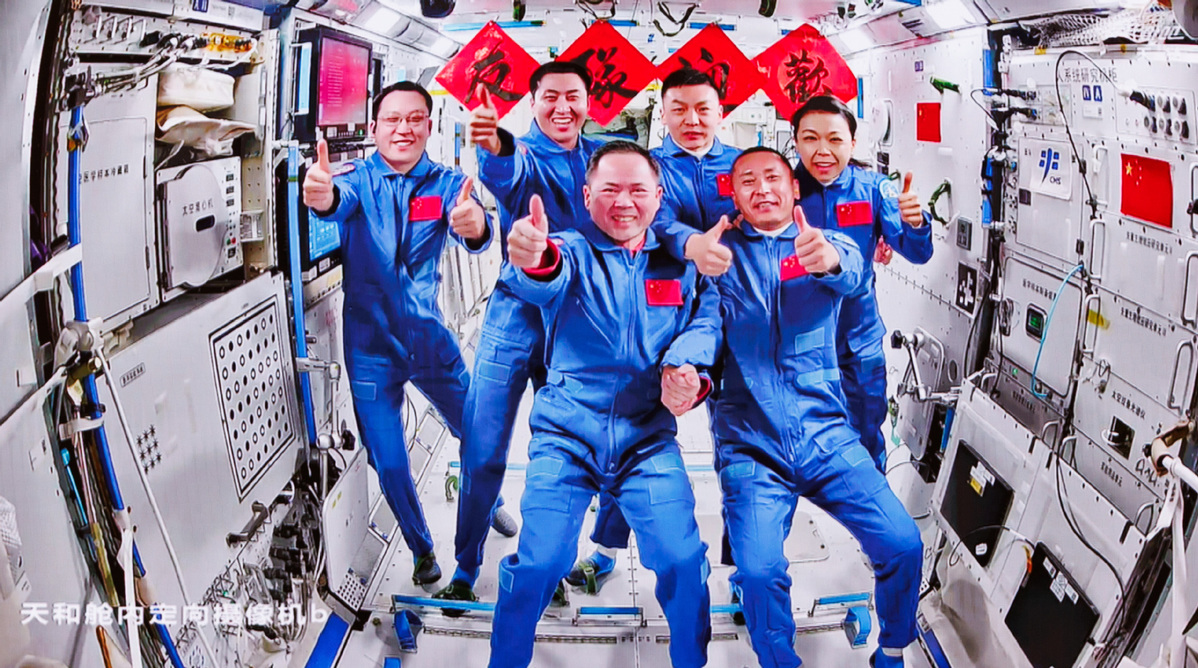
After that, the Shenzhou XXIII crew spent some time preparing to open the spaceship’s hatch and enter the massive orbital outpost to meet their peers, the three astronauts from the Shenzhou XXI mission who have stayed in space for nearly seven months.
A notable member of the Shenzhou XXIII spaceflight is Lai, who works for the Hong Kong Police Force as a superintendent and technical specialist. She has become the first female civilian in China to reach orbit and also the first astronaut from Hong Kong.
Before the police officer, three Chinese women — Liu Yang, Wang Yaping and Wang Haoze — all of them military personnel, had traveled to space.
The two Chinese civilian astronauts before Lai are Gui Haichao and Zhang Hongzhang, both male.
Lai has also become the first member of China’s fourth batch of astronauts to participate in a space mission. Moreover, she is the first from the global police community to journey into outer space.
A Hong Kong delegation, headed by Sun Dong, the SAR government’s secretary for innovation, technology and industry, participated in a ceremony to see off the astronauts at the Jiuquan center and then witnessed the launch of Lai and her teammates.
A mother of three, Lai was selected as a member of the country’s fourth batch of astronauts in June 2024. She and an applicant from the Macao Special Administrative Region, whose identity has not been disclosed, were chosen as science payload specialists after rounds of selection procedures.
The selection process of the fourth batch of astronauts, which was launched in October 2022, marked the first time that candidates from Hong Kong and Macao had the opportunity to join the nation’s astronaut group.
Zhang Jingbo, a spokesman for the China Manned Space Agency, said at a news conference on May 23 at the Jiuquan spaceport that Lai qualified for spaceflight with excellent grades.
Zhang, who is also a senior engineer at the agency, said that since the Hong Kong policewoman came to the Astronaut Center of China in Beijing in August 2024, she has completed more than 200 training subjects across eight major categories, and has accumulated more than 1,700 training hours.
Zhang said that the Shenzhou XXIII team is tasked with operating and maintaining the Tiangong space station, conducting science and technology operations, carrying out spacewalks to install and recover equipment, and performing educational activities.
The crew will conduct more than 100 new scientific and technological projects.
The spokesman noted that one of the crew members, who is yet to be determined, will stay for a whole year on Tiangong. The one-year stay is designed to achieve three major objectives, he said.
“First, it will be the foundation of China’s first space-based human body research program to gather the involved astronaut’s health data in extended spaceflight and accumulate experience for subsequent missions. Second, it will verify our capabilities to ensure astronauts’ health during long space travel and refine the in-orbit medical treatment and protection system.
“Third, the yearlong stay will provide opportunities for continuous long-term research on scientific projects and relevant technological demonstration,” Zhang said.
Shenzhou XXIII marks China’s 17th manned spaceflight and also the 11th crewed mission aboard Tiangong, which is now orbiting Earth at an altitude of about 400 kilometers.
Contact the writers at zhaolei@chinadaily.com.cn
