

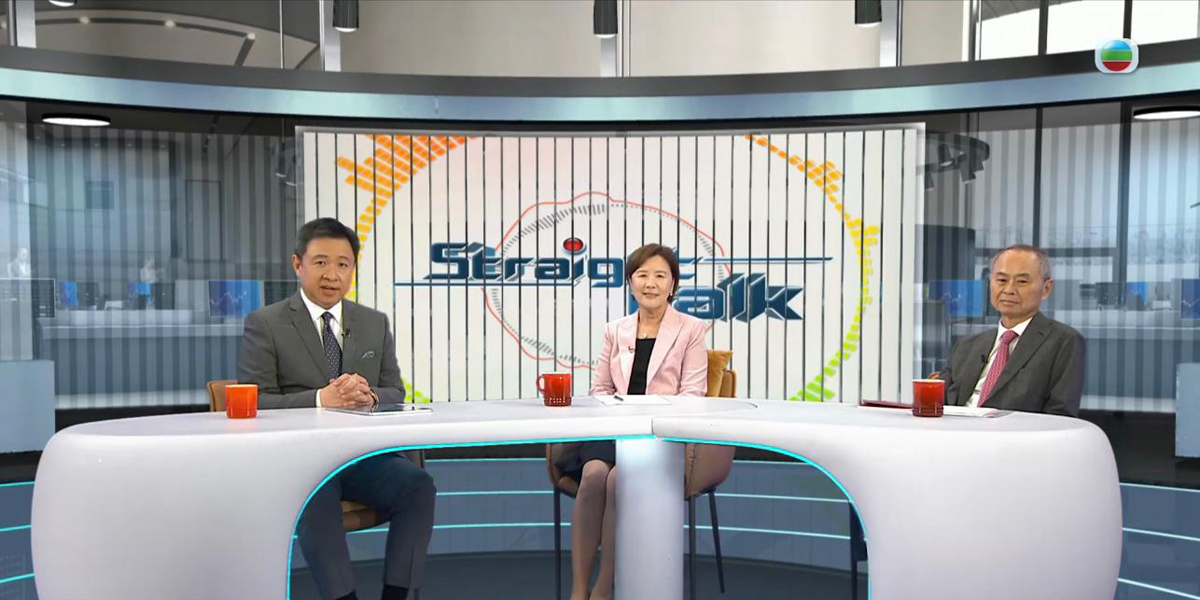
Hong Kong University of Science and Technology (HKUST) has been selected to establish the city’s third medical school. Joining us this week on Straight Talk are Professor Nancy Ip and Professor Fok Tai-Fai, to discuss what this means for Hong Kong and how our city stands to benefit.
Check out the full transcript of TVB’s Straight Talk host Dr Eugene Chan Kin-keung’s interview with Professor Nancy Ip and Fok Tai-Fai:
Chan: Welcome to Straight Talk! I'm Eugene Chan. Hong Kong University of Science and Technology has been selected to establish our third medical school. Joining us this evening are Professor Nancy Ip and Professor Fok Tai-fai to discuss what this means for Hong Kong and how our city stands to benefit from it. Ip is president of HKUST and a world-renowned neuroscientist, known for her groundbreaking research in neurodegenerative diseases. Since December 2022, Ip has also served as the Deputy from the Hong Kong delegation to the National People's Congress. Fok is a distinguished pediatrician, former dean of Medicine at the Chinese University of Hong Kong, and now a senior advisor to the president of HKUST, serving as a member of the Steering Committee for HKUST School of Medicine and the director of the Interim Executive Office for HKUST School of Medicine. Welcome to the show, both professors!
Ip: Thank you.
Fok: Thank you.
Chan: Let's start with the president, since she's the one who's running the ship. Firstly, congratulations on being selected to run the third medical school. Maybe you can share with the viewers what motivated you and your team to pursue this establishment of Hong Kong's third medical school.
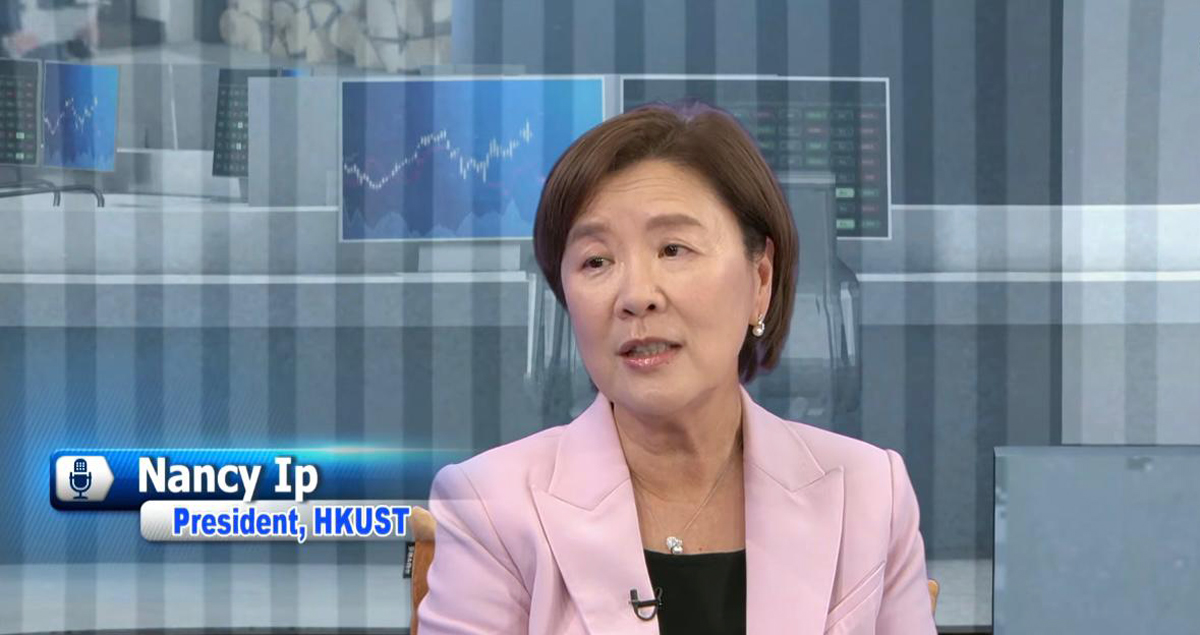
Ip: Actually, the idea of establishing a medical school at HKUST has been our aspiration since the founding of the university. But because setting up a medical school is a huge undertaking, it has remained conceptual for three decades. And about three years ago, we thought the timing was right, because after decades of effort, the university has already established very strong research foundation and also has very strong financial accomplishments. So, we felt that the timing was right. And at the same time, because of the aging population, because of the shortage of doctors, and importantly, because of the technological advancements, you know, like AI, it has already transformed all sectors and medicine is no exception. It is really time for us to train the next generation of doctors. You know, doctors who not only have excellent clinical skills, they also embrace technology to provide better patient care.
Chan: Right. Nancy, Secretary Lo of the Bureau, said that at the press conference, HKUST was chosen because it had a very sharp strategic positioning and a very wide global outlook. I think a very good compliment. So, can you elaborate a bit more to us what he meant by that?
Ip: I think the sharp positioning refers to the idea that we want to integrate technology with medicine. You know, this is the trend. So, we are training doctors not for today, but for the future. So, these are future-ready doctors who would embrace technology with medicine. And HKUST is uniquely positioned to do that because HKUST was the first research university in Hong Kong. We actually place emphasis on interdisciplinary education and research. In order to integrate technology with medicine, we believe that HKUST has the unique advantage to achieve that.
Chan: But how about in terms of global outlook?
Ip: Well, HKUST is one of the most international universities in Hong Kong, and we collaborate with many international partners.
Chan: I see.
Ip: And to prepare for the establishment of the medical school, I actually have led delegations to visit many medical schools, top medical schools around the world, in the US, in Europe, etc. So, this actually provides us with the knowledge about how to set up a top medical school.
Chan: Okay, Professor Fok, now it's your turn. I think the title of the show is asking us “how do we benefit?” So, I'm going to ask you directly, how will this third medical school benefit Hong Kong?
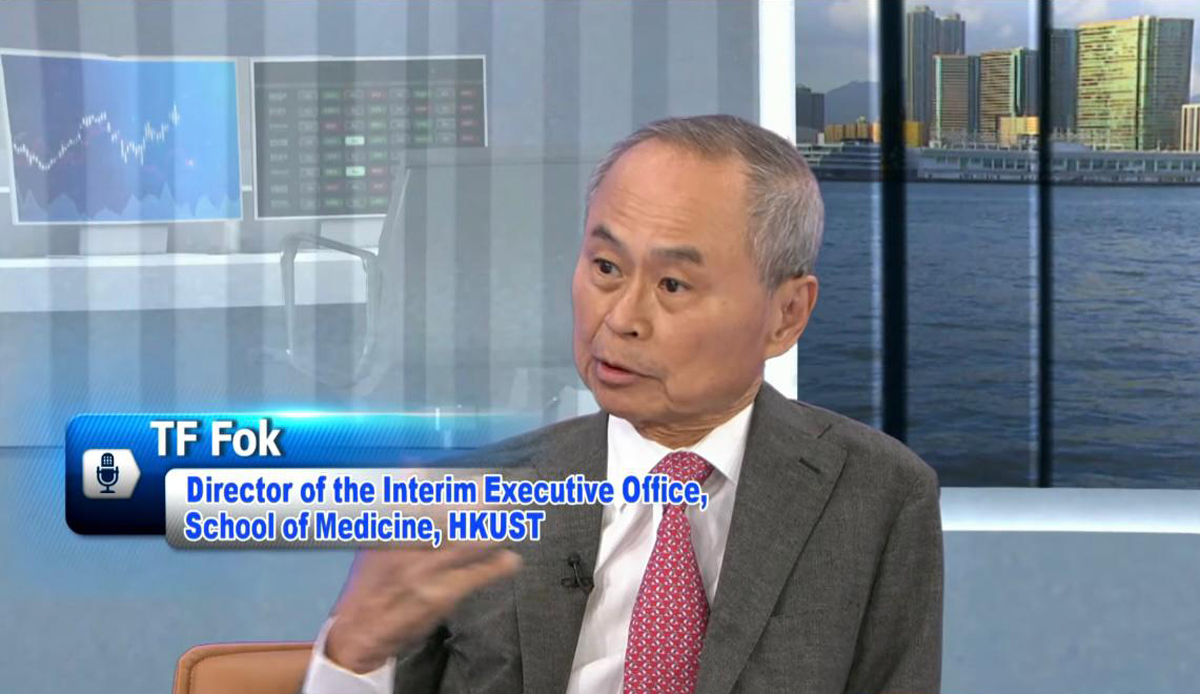
Fok: Well, a very simple answer to the question is, of course, we're producing more doctors to serve our community. But we certainly would like to do more than just that. You know, we want to make a difference to the medical education in Hong Kong. Our curriculum is going to be technology driven, and we are going to turn decisions, or technology savvy, scientifically minded, and also to integrate data science, AI, and engineering. Now, as you know, we are facing very serious challenges in our healthcare service, the aging population, the severe shortage of manpower, and also the ever-escalating healthcare cost. Now this is going to make our healthcare service unsustainable and unaffordable. And we believe technologies are going to provide the solution for all these challenges.
Chan: Right, so you're saying that this is the reason why you have a third medical school especially targeting our shortfall of what's happening in Hong Kong.
Fok: Absolutely.
Chan: Right. I'll come back to Professor Ip again. I mean, HKUST is the best known globally for science, engineering, and innovation, yourself being a great scientist. So, how does this sort of DNA that HKUST has translate into medical education?
Although Professor Fok said this is our aim, actually to deliver it is another matter. Because whoever you're going to invite to be lecturers, they are not sort of being trained that way as well. How are you going to plan to have your DNA implanted into your new staff?
Ip: Yeah, I think the first step is to make sure our curriculum can integrate technology with medicine. So, we are building from ground zero, right? So, for the curriculum, we can design it such that the important components of the technology can be embedded in the curriculum, in the courses that we teach our students. So, we can do that by integrating the various technological components in every course that we teach. For example, if we teach cardiology, then we would show the students how technology can improve the diagnosis, for instance. All this can be embedded from stage zero. So, from the ground up, we can build it that way. We're also recruiting students that have the first degree, right?
Chan: I see.
Ip: So, they are more mature students and they would come to our medical school with different backgrounds and that would also enrich our students' learning experience. And importantly for HKUST, since we place emphasis on innovation and entrepreneurship since the founding of the university, we can also help to ensure that the research discoveries can be translated and in the end can be implemented in the clinical setting. So, all these, I think, we can design it from the beginning so that from the curriculum perspective, from nurturing the students to be clinician innovators.
Chan: Right.
Ip: So, they are not just excellent clinicians, but they also have the mindset. They have the scientific mindset. They also have the technology literacy. All these will enable them to provide better patient care. And if they are interested to have their own startup, they can also do so.
Chan: Good.
Ip: And they can have all kinds of possible career paths in front of them.
Chan: Right. TF, since Professor Ip has said that the DNA will be translated. I mean, you being a dean of medicine before, you know, Hong Kong is quite famous for good doctors. So, it looks like we're going to have a more matured lot of, sort of entry-level sort of students. We're going to produce a very different batch of doctors coming out. Do you think this is going to make Hong Kong even stronger as a healthcare hub in the area?
Fok: Actually, putting more emphasis on technology is a global trend. We think we're in a good position to do so, because we are starting from the scratch. We don't have any historical baggage, no tradition, no vested interest. We can recruit whoever is suitable for our purpose. So, this will make HKUST stand out as a very good place for starting this new experiment.
Chan: Right. But TF, I must ask you a direct question. We know that medical curriculum used to be like five or six years in Hong Kong, and now you're having a four-year program. How do you ensure the curriculum will cover all that is needed, because time is shortest by one to two years? Is that doable?
Fok: Yes, we think it might be seen as an ambitious goal, but it's achievable now. Because first, we are not going to compress a six-year program into a four-year program. We're going to integrate the new things, the technologies, engineering concepts, and AI and data science into medical studies. So, we are not copying or just importing from a six-year program and compress it into a four-year program. And secondly, you and I have gone through medical studies. We know that there are a lot of things that we learn, or so-called learned, actually are not necessary. So, we can actually trim off a lot of things if we are good enough and careful enough in redesigning our new curriculum.
Chan: Right.
Ip: Yeah.
Fok: And we can do that again because we don't have the historical background and we don't have the …
Chan: So-called baggage.
Fok: … the baggage.
Ip: Yeah, and also I would like to add that in the US actually the curriculum is also four years.
Chan: Right.
Ip: So, they also take in students after they have their first degree, and it's a four-year curriculum. So, what we are doing here in the medical school is the same.
Chan: Okay.
Ip: So, we have graduate entry and it's a four-year curriculum.
Chan: Right, thank you for the reassurance. And let's take a short break now and we'll be back with more Straight Talk.
Chan: Welcome back to Straight Talk. We continue our discussion with Professors Ip and Fok of the Hong Kong University of Science and Technology, examining what Hong Kong really gains from establishing a third medical school. So, to both professors, thank you for reassuring the viewers that it's going to be a new curriculum, it's going to be built for Hong Kong's future, and that it won't be compressed, and this is as good as anywhere in the world. I think that's the point we have made so far. So, I want to go back to TF. I'm going to talk about the students. Your first intake will be in 2028. So, what type of qualities and backgrounds will you be looking for? I mean, the president has said the more mature students will be able to apply compared to Hong Kong current situation where many are from the high schools. What type of quality should we be looking at? I'm sure the viewers are going to ask you directly.
Fok: Well, certainly it's a graduate entry program. So, all the applicants must have a recognized degree from the recognized university.
Chan: Hong Kong or overseas?
Fok: Doesn't really matter. It's either Hong Kong or outside of Hong Kong. And then, but we also look at their personality and characters as well, the maturity, whether they can practice ethically with professionalism and empathy and so on. And then of course we also require them to sit for the MCAT or GAMSAT test because these are the two well-recognized and widely used standardized tests for graduate entry programs worldwide. So, we think all our students must have done these two tests, or either of the two tests.
Ip: Yes.
Fok: And secondly, all students will be evaluated through a personal statement and also through recommendation by either their academic tutor or employers if they are already working. And thirdly, there is going to be a structured interview, you know, to look at their behavior, their personality, and so on.
Chan: So, it's a very different sort of admission criteria compared to the current, the other two medical schools?
Fok: Yes.
Chan: That select purely mainly on their academic merits.
Fok: Yes. That’s right.
Chan: And I’m sorry, professor, how about in terms of ratio wise between local students and non-local students? Would this be a good opportunity for us to train some overseas doctors, some, I won't say too many, because it's good to have a bridge because I'm sure TF and I will agree, people who have graduates from other universities will bring a lot of connections, a lot of new sort of culture into a Hong Kong scene that is going to be beneficial.
Ip: Yeah, absolutely.
Chan: What would be the ratio? Will there be a fixed ratio?
Ip: Yeah, so currently there's a cap of 50 percent non-local students for undergraduate admission. So, for the medical school, we will follow the same sort of guideline. So we'll be targeting no more than 50 percent of local students. And they can come from different countries with different backgrounds. And again, the key is to ensure diversity.
Chan: But will Hong Kong-based or Hong Kong originated from Hong Kong sort of have any preference compared to an African or actually American? Do you have that preference?
Ip: I think both. Yeah, I think local students, non-local students from different countries, we welcome them to join our medical school.
Chan: Okay.
Ip: As long as they have the attributes that TF, Professor Fok mentioned earlier, you know, they need to be compassionate, they need to have the attributes of empathy, curiosity, integrity, etc. So, I mean, these are the qualities that we'll be looking for, you know, their commitment, you know, to take care of patients, etc.
Chan: Right, since we are on that medical school, let's move on to sort of more practical issues. How's the progress of building the school? Is it on time, on the schedule, and any milestones has been sort of been made so far? And are you confident that we can start in 2028? Isn't it what's the first batch?
Ip: Yes, I think our first cohort will be admitted in 2028. So, since the government announced the third medical school will be established by HKUST on Nov 18, we had our kickoff meeting with the Health Bureau, Education Bureau and Development Bureau on Dec 4.
Chan: Right.
Ip: So, at that meeting, we discussed what the immediate next steps are. So, we are working closely with the government and we have their support and we are so grateful for that. The government has the task group and under that there are three working groups and we are working closely with them. For example, to look at the curriculum development, faculty development, teaching hospital, also the infrastructure and finance, etc. So, all these are ongoing in progress. And so with the curriculum aspect, we're working closely with the Medical Council of Hong Kong, with faculty recruitment. Of course, the most important one is the Founding Dean. And then with the infrastructure, the interim solution is to build a teaching and learning building for the medical school on our Clearwater Bay campus.
Chan: That would be for interim purpose, is it?
Ip: That's right, for the interim purpose, because in the long term, the permanent site of the medical school will be in Ngau Tam Mei of Northern Metropolis. There will also be a new teaching hospital with 3,000 beds right next to the medical school in Ngau Tam Mei. That's part of the Northern Metropolis development. So, again, our immediate next steps would be to identify the Founding Dean of the medical school, to have the curriculum having in principle accreditation approval by the Medical Council, to ensure that our interim medical school building is ready in 2028. So, all that are in progress.
Chan: Right. Professor Fok, since the President said that we have to look for an interim dean, let's not touch on that issue. How about the actual faculty? I mean, being in the healthcare profession, I know that it's not easy to find the very, the top-class medical teachers. I mean, some great doctors, they may not be the best teachers, especially you are not integrating technology and AI into the curriculum. Where are you going to help recruiting the faculty staff?
Fok: Actually, we are delightfully surprised by the enthusiastic response from an international group of doctors, of academic medical educators from North America, Europe, Singapore, and …
Ip: Australia.
Fok: Australia.
Chan: Really?
Fok: So, we don't fear that we have a shortage of faculties. Actually, we are looking for outstanding academics who are committed to medical education and mentoring the younger generation of doctors. I think that's one of the most important attributes that we are looking at.
Chan: Maybe that's why Secretary Lo said that you would have a winning edge in terms of competition and attraction in recruiting professionals.
Fok: We hope he's saying the right thing.
Ip: I think a lot of candidates, faculty candidates, they are really excited about the opportunity to play a part in the establishment of the new medical school. Because it's a brand new curriculum and it's a new model for education. So, a lot of the faculty candidates, when they approach us, they express their keen interest to play a role in the founding stage of a new medical school.
Chan: Well, I think it's very encouraging to hear of all these positive views. But having said all that, I think I must go to the crux of the matter. We have to look at the finances. Having a beautiful medical school is not going to be cheap. We all know that. How are your models going to make sure it's going to be sustainable? Would it be very high school fees or would you have a lot of philanthropic support from funds or what would be your plan?
Ip: I think it will be a multi-source funding strategy that we have. We, of course, you know, we have the government support. And the university also, we are committed to contribute substantial resource to support the establishment of the medical school. We will also count on philanthropic support. And of course, we will continue to come up with new revenue streams. How do we generate income to make it sustainable in the long term?
Chan: Right.
Ip: So, this can include, for example, technology development and licensing, contract research, sponsored research, etc. So, I think, and also executive education, right, since HKUST has a very successful EMBA program by the business school. We will have this sort of multi-layer funding strategy and we believe that together all these approaches will make our medical school financially sustainable. And our medical school, again, you know, the ultimate goal, in addition to training doctors, will be to help Hong Kong develop into a world-leading hub for health innovation. And that in itself, we believe will be extremely important for the medical school to achieve.
Chan: Right. Okay, one final question for Professor Fok. Is a teaching hospital being identified or it will be an exceptional new one? That's a quick question.
Fok: I think we are working closely together with the Health Bureau and the Hospital Authority. So, I think everything is still being discussed on the drawing board.
Chan: Alright. We look forward to hearing from you. And thank you very much for both professors ...
Fok: Thank you
Chan: … for sharing your insights of third medical school. This is a major commitment of resources, talent and public trust. As we have heard tonight, the challenge now lies in the execution, delivering impact and ensuring Hong Kong truly benefits in the years ahead. Have a good evening and see you next week.
