

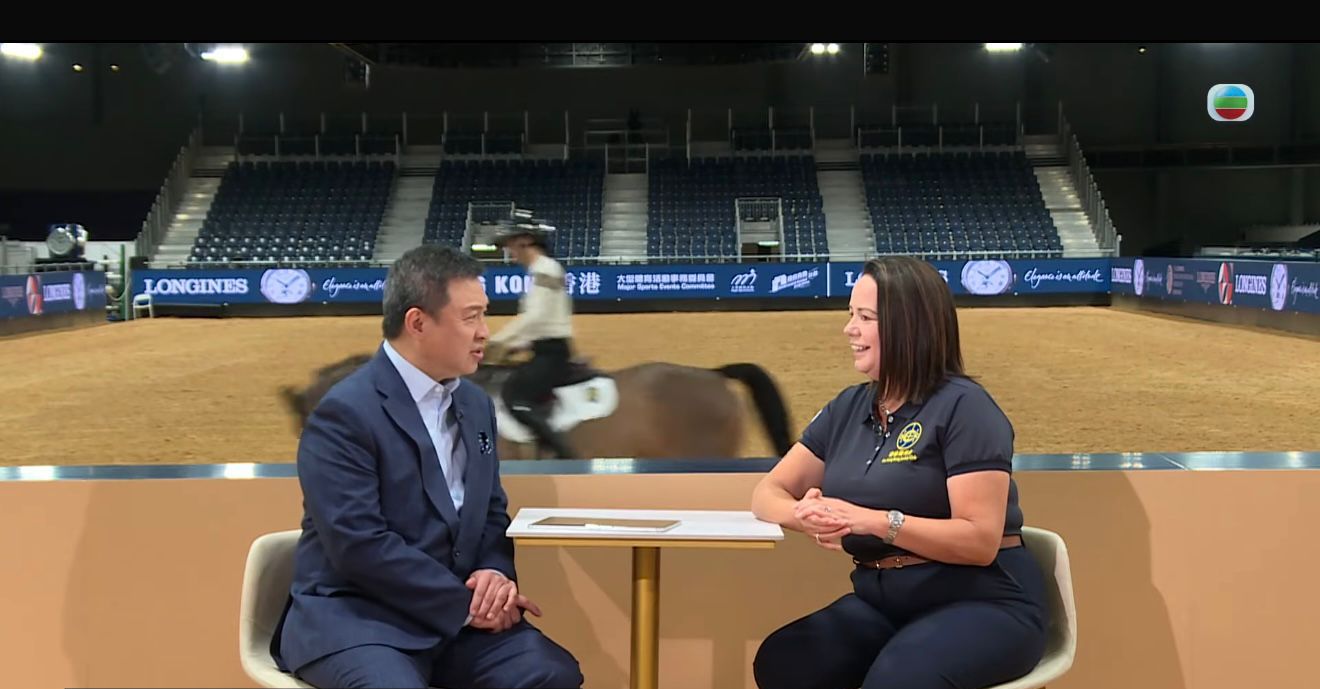
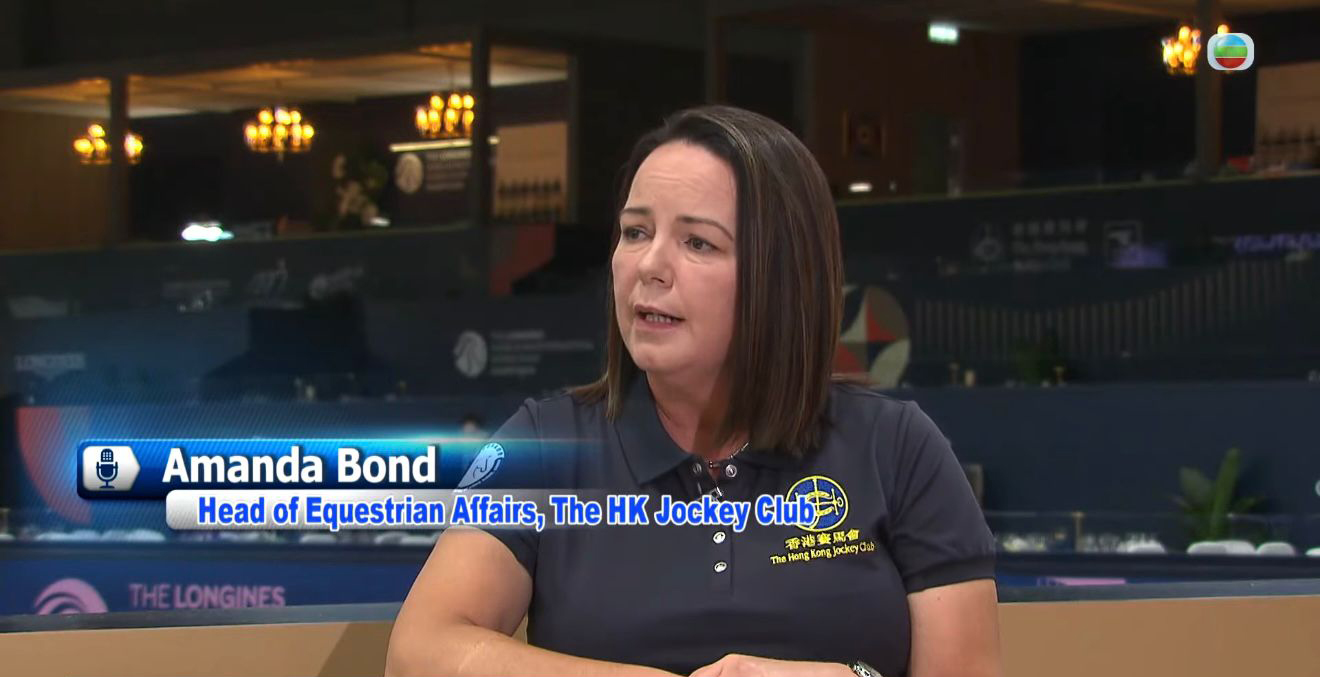
Amanda Bond, the head of Equestrian Affairs at the Hong Kong Jockey Club, is on the show to talk about the potential Hong Kong has to become an Asian hub for international equestrian sport events.
Check out the full transcript of TVB’s Straight Talk host Dr Eugene Chan Kin-keung’s interview with Amanda Bond:
Chan: Welcome to Straight Talk! I'm Eugene Chan. We are now at the Asia World Expo with Amanda Bond, who is the head of Equestrian Affairs at the Hong Kong Jockey Club. Amanda joined the Hong Kong Jockey Club in 2014, following five years as CEO of British Dressage, during which Great Britain achieved outstanding Olympic and Paralympic success. She has more than 30 years' experience in international equestrian sport, including work on several Olympic and Paralympic Games, and major FEI championships. Amanda is chair of the FEI Pair Equestrian Technical Committee, and a board member of the FEI, which is the Federation of International Equestrian Sports, and she oversees all Equestrian Affairs at the Jockey Club.
Horse racing has long been part of Hong Kong's identity. But could our city now become Asia's center for equestrian sport? Welcome, Amanda!
Bond: Thank you very much, Eugene!
Longines HK horse show
Chan: We are now at the Asia Expo. The Longines Hong Kong International Horse Show was here the last weekend. How important is this event in the national calendar for equestrian sports?
Bond: Well, this is a crucial event, because this is what we call a five-star event, and that's the highest level of events. It attracts many of the top competitors from around the world to come and participate here in our great city of Hong Kong.
Chan: Right. How many visitors actually do come to Hong Kong? I'm sure the viewers would want to say, like, for rugby, for football, we have a lot of visitors. Do we get visitors from over the world?
Bond: We do. Obviously, this show is in its second edition. So, we're looking to attract more interest, but we're already seeing, even in the second year, a lot more tourists coming in, and the fans coming in, particularly from the Chinese mainland, and also from around Asia. One of the new things we've added to this show this year is an Asian Youth Challenge, where we've actually invited riders from different Asian nations, for example, Thailand, Cambodia, Chinese Taipei, many different nations, giving a chance for young athletes to participate in this wonderful environment that we see. But that also has brought fans from those countries as well. So, I think all of these initiatives help to create Hong Kong as this global hub for equestrian sport.
Building an equestrian ecosystem
Chan: Amanda, a few weeks ago, we had two of your team members – Raena Leung and Samantha Chan – here. And a lot of youth have told me that they didn’t know Hong Kong has such a good team, and that it's a very attractive sport but not too familiar for most of people. Before we go any further, how popular actually is equestrian in general, and which are the most popular countries for this?
Bond: Well, equestrian actually is a very popular sport globally. We have about 44,000 athletes around the world competing in an international level in equestrian sport. But it would be millions of people who participate as amateurs and, you know, and just enjoy horse sport. In terms of the countries that are where it's most popular, if you look at Germany, I think it's the number one sport, it's very, very popular. Germany, France, the United Kingdom, it's very, very popular in those countries. I think in Asia, we're just emerging really as a sport here, and I think there's the potential for it to be much more of a growth sport here in this region.
Chan: Right, Amanda, before we go any further, I'm sure the viewers are going to ask me “Eugene, why are you having two shows on equestrian?” There must be something that I can see. Maybe you can share with the viewers, if Hong Kong becomes a hub in Asia, what would that bring to Hong Kong? And what is the niche that we can do for Hong Kong?
Bond: Well, you know, the unique thing about equestrian sport is it's the only Olympic sport that involves another being, you know, the horse. You know, and I think the horse is magical, and that partnership between the human and an animal that come together, and we had a campaign within the FEI called the Two Hearts campaign. And if you think about it, that's what happens. You have those two hearts of the horse and the human coming together in that special partnership, and when you see them in action in the arena, that's what you really see, it’s that true connection. And I think that's what makes our sport unique. And, so, when we look at it in terms of what it can bring to Hong Kong, horse racing for many years, 140 years has been immensely popular in Hong Kong. There is this love of the horse, and what we want to do is kind of bring this, to a younger generation, for people who can also participate, because actually you can participate in riding and get involved in equestrian sport easier than you can in racing. And equestrian, particularly in young people, develops a sense of responsibility, a sense of partnership. You know, most of our young athletes have to work immensely hard to take care of the horse, early morning training, training every day. It's actually quite an intensive sport where you have to work very, very hard. So, that develops great qualities in young people.
Chan: Since you brought it up, I remember Samantha was saying to us that you have to wake up, like, 6 o'clock in the morning, or 5 o'clock even.
Bond: Yes.
Chan: To be with the horse, and be with the horse for the whole day.
Bond: Yes.
Chan: That's very demanding, isn't it? I mean, is Hong Kong the place for such sport, honestly?
Bond: Why not?
Chan: Okay.
Bond: Yes, no, absolutely. I think, you know, our athletes, one of the things we do with our young athletes is, we say to them, “Look, it is going to be tough. But it's like any career. If you're going to be at the top of your game in any career, you have to work hard, for sure.” So, this is … equestrians are no different. But I think what it is, is it's quite a physical sport as well. And you have to take time to build that connection with the horse. And that's what I think Sammy is referring to is the time that it takes to build that relationship with your horse and that commitment that you have to put in.
Chan: Right. I think another area that we had to chat before the show is, why at Asia World Expo? Why aren't we having it at Kai Tak, which is a lot closer?
Bond: Yes.
Chan: Can you tell the viewers why are we here?
Bond: Yeah, sure. I mean, Asia World Expo (AWE), when we first started to bring a horse show into Hong Kong of this high level. We have to bring the horses in. We've got some horses in Hong Kong, but if we want to have the best competition in the world, we have to fly the horses in from different locations. So, coming to Asia World Expo, we're close to the airport, it's easy for many of the visitors to come. AWE provides us with the space. Not only have we got the arena that we see here in the background. But actually, back of house, we've got horses. The horses are staying here. The athletes are staying in the hotel next door. So, everything is sort of, has the space to house here. But, yes, for sure, you're right in what you say, in that Kai Tak is a much more central location. It can be difficult to bring the fans from the city out to Asia World Expo. So, I think Kai Tak is an ... Now it's open and functioning … I think it's an interesting proposition. For us to think about and maybe explore for the future.
Chan: Right. And also, you were telling me earlier, you were sort of flying in, like, 50 plus horses, all the way from different parts of the world.
Bond: Yes, correct.
Chan: And how do you deal with all the, I mean, immigration through, as you say, it's sort of a quarantine, about security, and even the vets care?
Bond: Yes.
Chan: Can you tell the viewer how demanding that is?
Bond: Yes, it's complicated bringing a horse show like this to Hong Kong, but not impossible. So it all starts with the fact that, you know, racing is so important here. We have to make sure that we take care of the local population of horses. And that we don't do anything by bringing horses in from outside to risk the health of our horses. So, we have to have very strict biosecurity. We work closely with the government on that. We have what's called a bubble. All the horses that have flown in are basically in this sort of protective bubble, where they're not mixing with our local population of racehorses. So they're here with very strict management. We've got our veterinary team here to make sure that there's no crossover between the health status of the horses coming in and the health status in Hong Kong. And actually, even before those horses come in, they've been through very strict testing. So, they've been tested for all of the main equine diseases to make sure that they're super healthy before we bring them in, and then also taking them home again. Making sure that we don't risk the horses that are here, that are going back into Europe. So, we have to be very, very careful with that. But it's a tried and tested method that we're very successful with now. I mean, I'm sure a lot of viewers will remember that Hong Kong hosted the Olympics for equestrian in 2008.
Chan: Yes. It seems like, what, 18 years from now? It’s a long time.
Bond: Oh, Makes me feel old. Don't say that.
Chan: Sorry. I mean, recently, we had the National Games in Hong Kong, where we worked with the GBA. We are talking about the GBA in the second part of the show. Hong Kong seems to be having the ability to host major events, given we’ve done well in the National Games. So, with this event just being through the second time, how do you see Hong Kong, as my title asks, “Can we be the hub for the equestrian events?” Because Hong Kong has all the hospitality, we've got a great airport, and we've got, I mean, great service for people? What do you think?
Bond: Well, do you know, I think with the Hong Kong Jockey Club's expertise in, obviously, we've got generations of expertise in racing. We're very experienced at caring for horses, bringing horses in and out, and that's the reason why, when, you know, Beijing 2008, Hong Kong was chosen to be the host for equestrian sport, for that very reason. And that gave us great experience. In addition to that, we've used that expertise in Asian Games. So, for example, in Guangzhou and Hangzhou, we've also supported on those games in Chinese mainland. So, now bringing this horse show into Hong Kong, I think, we're doing it in the same way. So in the Olympics, I talked about the bubble, the Olympics was done in that same bubble. And so, using that expertise. And so I think when we talk about Hong Kong being a leader in Asia, I think definitely it's around Hong Kong's expertise to do that, our thought leadership in doing that. It's not so easy for Hong Kong to have, you know, dozens and dozens of top level equestrian events because of this horse movement scenarios.
Chan: You mentioned earlier.
Bond: Yeah, so I think more so now, it's more about us. Yes, for sure, bringing, you know, one of the top events in the region here. But then also using that expertise and knowledge to help other Asian nations as well, also to host events and things. So, I think it's about Hong Kong leading the way. You know, and being that thought leader.
Chan: Right, Amanda, time for a short break now, we'll be back with more Straight Talk.
Chan: We are back on Straight Talk with Amanda Bond, Head of Equestrian Affairs at the Hong Kong Jockey Club, talking about the Longines International Horse Show and what it means for Hong Kong's growing role in the equestrian world.
Chan: Amanda, thank you for introducing, I would say, the system of equestrian in Hong Kong. And I am glad that we had Raena and Samantha recently. So, let's move on maybe further down the show. If you want something to succeed in Hong Kong, I am sure the Chief Executive and our officials have been thinking apart from the Rugby Sevens, apart from our international football events, what is next? There is a reason why I thought this could be a possibility. So, to build an ecosystem, you need horses, you need venues and riders. With horses, someone told me they can be quite expensive. Is that a myth or is it the truth?
Bond: Well, it is a little bit in between, it depends on the type of horses. If you are looking, you know, the horses that we see at this event here, they can be quite expensive. It is the same with race horses, the very top level, those horses can be expensive. But equally, at the entry level of the sport, it is much more affordable and it is much easier to do. So, yeah, there is a whole variety of different types of horses that do this.
Chan: Right. In terms of venues, in Hong Kong if you want to participate, I mean not at this event, where can you do it?
Bond: Well, actually… given Hong Kong is so small, I think actually we are well served by a number of different facilities. We've got … the Jockey Club has got three public riding schools.
Chan: I see.
Bond: And then of course we have the Beas River Equestrian Centre, which is a sort of national equestrian center that we use for horse shows and different events. So we are very lucky. And there as also a number of private riding clubs as well that serve the needs. But the challenge we have is it is never… with equestrian is growing all the time, and having events like this grows that fan base more and more, people, children and adults want to learn to ride. But now the waiting lists to actually get a riding lesson are very, very long.
Chan: Is it really?
Bond: So, all the time we are working to try and provide more opportunity for people to ride.
Chan: One area I must ask you and you are the best person to tell me: if you are going to play football, it is easy because it is get a ball and you are ready to play, but with equestrian, you need a horse, you need a venue, you need coaches, you need to be able to do international events like in Germany. Is the, what we call, the barrier to entry a bit high, do you think?
Bond: I think in Hong Kong, it certainly can be difficult to find that opportunity because as I mentioned, space and those opportunities, it is difficult. We've been looking for land to build more riding schools in Hong Kong, but as we know, in Hong Kong we have to prioritize housing for people, so it is not so easy just to find large spaces to build riding clubs. But we are very clever with how we do it, to try and make as much opportunity, lessons in the early morning, lessons in the evening, throughout the day. So, to try and cater for that demand. And I think once people are riding, there as quite a good network of support around. I think in Hong Kong, athletes, once kids decide that they want to do this and take it seriously, there is incredible support. And we are lucky that we have the Hong Kong Jockey Club, who fund a support program to provide the world's best coaches, we have great horses that we provide to some of our young athletes, and the opportunity to go overseas and train and compete.
Chan: Will you say equestrian is a game for the privileged or for the rich? Sorry to be very...
Bond: No, no, no. It is a question that we get asked a lot. It can be. And certainly there are a lot of wealthy people who are in our sport. But equally, there are people, ordinary people like me. I am an ordinary person, I come from a very normal family, not a wealthy family. And I even remember when I was 14-15 years old, and my parents telling me not to have a career with horses because that wasn't for me. But actually working hard and that determination to want to do it, you can break through. And there is a number of Olympic athletes who've come from ordinary backgrounds. But if you have talent, that talent gets recognized and then you get given opportunities with best horses.
Chan: Say for the past 20 years, including the 2008 Olympics, what are the milestones in equestrian history in Hong Kong that you have witnessed?
Bond: Well, I was very lucky that in 2008, I was here. I worked for the organizing committee back then, and that really, I think, was that seminal moment for equestrian sport in Hong Kong because it brought the world here and it got Hong Kong recognized. And I think what… again, because we did it so well, we delivered it because we have that expertise that we learned upon from racing, the world started to realize that actually Hong Kong was something to be recognized. And I think from then we've gone on, as I mentioned previously, we helped to host two Asian Games with our partners in the Chinese mainland. Also here, I think our athletes, through our development program, our Hong Kong equestrian performance program, we've helped support athletes to go on and then compete on the world stage. So, you talked about Raena and Sammy that have been on the program. Other athletes as well, Jacqueline Siu for example, going to the Asian Games in 2018 and winning Hong Kong's first ever gold medal, individual gold medal in dressage in equestrian. That was a really special moment. And then going back to the next Asian Games, where we won two medals. So, all the time our program is developing. And the most rewarding thing is when we see the young athletes come through. People like Sammy Chan who've come up through a youth development program, and then gone on into senior teams and winning. And she's won medals now in a couple of different championships. So, I think that really shows that even though in Hong Kong, Hong Kong's tiny.
Chan: It is very small.
Bond: We've got 400 members of the Equestrian Federation. So, you imagine if you are looking in a talent pool. When I was in the UK, I came from the UK, we had a million people ride horses. Now in Hong Kong, as I mentioned, 400 people are members of the Equestrian Federation. So, finding talent is not so easy. But I think what we are doing is we are identifying that talent, and we are really supporting and developing.
Chan: It looks like we have done well.
Bond: We have.
Chan: I mean a lot of people have said to us Hong Kong is really a city. Look at all the Olympic gold medalists we have.
Bond: Yeah.
Chan: We've done very well, thanks to the government. So, the Jockey Club has been doing a lot. Is the government doing enough for you?
Bond: The government does help support us a lot. Our athletes all work through the Hong Kong Sports Institute. And they get a lot of support from that way. And so yeah, I think the challenge for us if we are going to get to the nuts and bolts of this, the challenge for us always comes down to horsepower.
Chan: Right.
Bond: Because I talked about it is a partnership between a human and a horse, we can't do anything without great horses. And I would say that for us is the next big challenge, it is how do we secure the horse power. Sometimes, as you mentioned, it is very expensive. How do we get the horse power that we need that will take us to Olympic Games? And that I think is where we need to call upon, whether it be government or whether it be the community to try and all come together to say “okay, look, how can we do this? How can we compete with the best in the world?”
Chan: Right. Amanda, I must ask you even a more direct question because I've been talking to different people about the sports in the program. I think in all sports, family support and also maybe corporate support is very important. But in Hong Kong where it is not as popular as golf or tennis yet, there may not be as much corporate sponsors. So, that means the family or individuals have to come up with resources. For example, if you want to be in Germany, you've got to be there, you've got to fly there, you've got to live there, you've got to actually get something done there. So, is enough support being given to the athletes? And if more support is given, do you think we will be even more successful getting more staff, therefore helping Hong Kong in general?
Bond: Yeah, absolutely. In a way, you have hit the nail on the head. You mentioned about families, and I would say we haven't achieved anything without the support of those families. So, I have to do a shout-out to all those families of our athletes that are there helping support them. And we are, I mean again, I don't want to keep going on about the Hong Kong Jockey Club, but we do get immense support, probably more than any nation in the world, we get tremendous support ,thanks to not just funding, but also that kind of emotional support that we get from the club, that passion from the club. But certainly I think us starting to attract more corporate sponsorship and… or so individual horse owners, people who get passionate about the sport and maybe want to invest in horse power because they really want to see Hong Kong do well.
Regional & global influence
Chan: Right. Amanda, I want to move on just a little further from Hong Kong to GBA. We talked about integration with the Greater Bay Area. Is that an opportunity for Hong Kong's development? Because we must develop on our niche, and that is the reason why Straight Talk has been inviting people to come out and let Hong Kong people know we must have the hope and we must have the vision. Is equestrian something that we can, I won't say lead to work closer with the GBA cities and then all of us prosper?
Bond: Do you know this is probably the thing I am the most excited about. I touched on one of the challenges here being space, but the more we work with GBA as partners, actually what that does is solve one of our problems in that it provides us with more space and more opportunity. And we saw it recently just at the end of last year with the National Games in equestrian, where equestrian was hosted in Shenzhen. And we partnered together with them to help deliver on that event. And so we see that there is a real opportunity to develop more in the GBA, and actually become a lot more connected in GBA. And it provides opportunity for our athletes. You know many of our athletes are Hong Kong athletes now are also participating in shows in GBA and in the Chinese mainland. And what it means is where I have got that tiny athlete pool in Hong Kong, actually all of a sudden the athlete pool is much larger, and it makes them more competitive. So, I think it offers huge sort of opportunities for us to do more. And you know, we had the Asian Games in 2010, and that obviously now has been developed into this sort of fantastic race course for the Jockey Club. So, there is many initiatives that are happening in GBA region that I think are really exciting for Hong Kong.
Chan: Right. Amanda, unfortunately that is all the time we have for today. Thank you very much again. And as we enter the Year of the Horse, Hong Kong is turning tradition into opportunity, carrying its racing legacy forward into an exciting new chapter in international equestrian sport.
Have a good evening and see you next week.
