

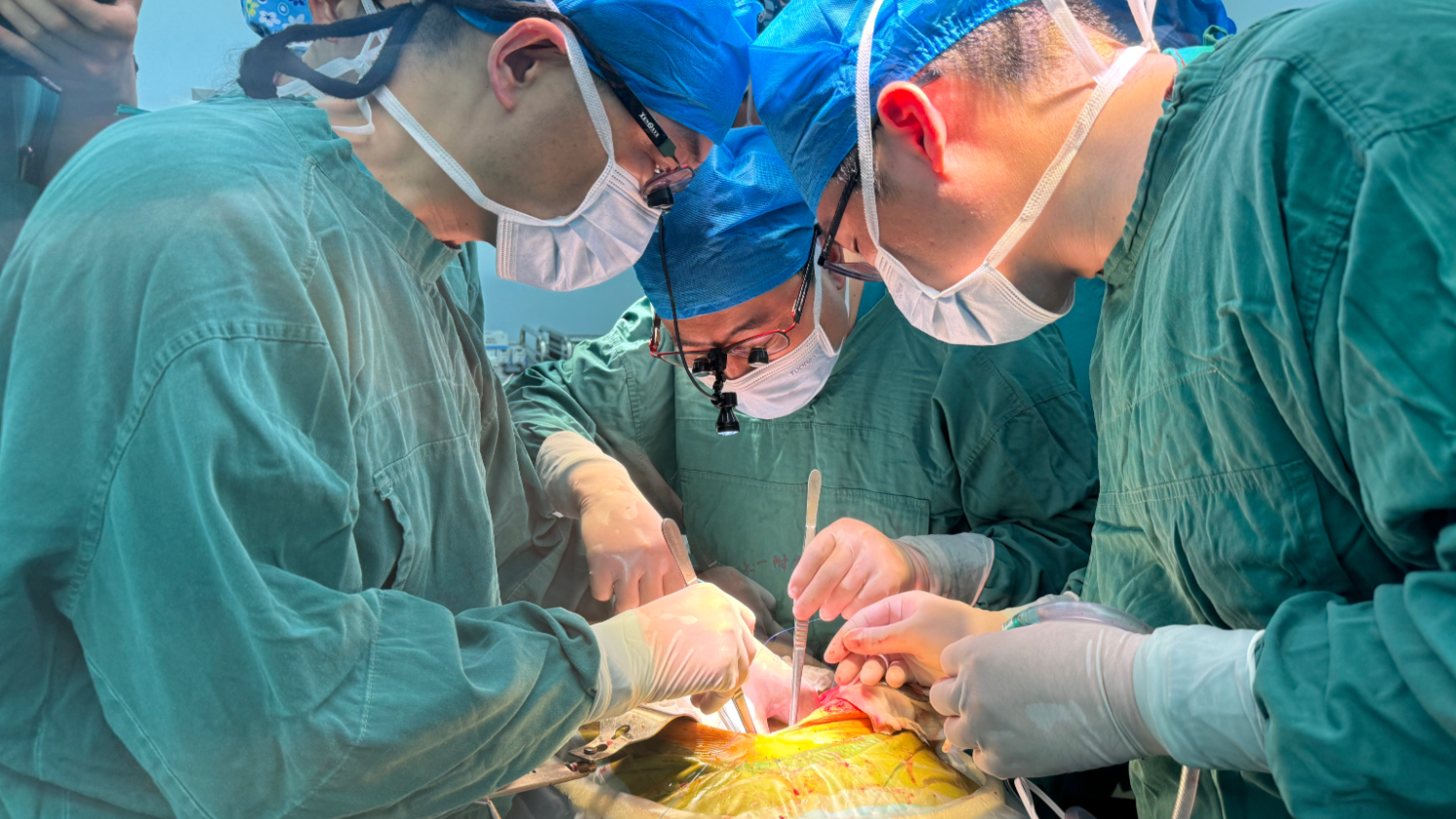
A patient with liver failure remains in stable condition two days after receiving a novel therapy using gene-edited pig liver — a treatment doctors at the Xijing Hospital in Xi'an, Shaanxi province, have heralded as a global medical first.
The procedure, known as extracorporeal perfusion, involves connecting a patient's circulatory system to a pig's liver placed in a mechanical device outside the body. Experts say the breakthrough provides a new strategy for treating end-stage liver disease and bridges the gap for patients awaiting transplants.
The medical team used a liver from a pig with six genetic modifications designed to reduce the risk of organ rejection. The organ was placed in a specialized perfusion machine and connected to the patient's femoral vein to establish a circulation system.
During the 66-hour treatment, which concluded at 10 am on Tuesday, the pig liver performed essential functions usually handled by the human liver, including detoxification, synthesis, and metabolism. The patient's own liver remained in place throughout the process.
After the equipment was disconnected, the hospital reported sustained and significant improvement in the patient's key liver function markers. Wang Lin, director of the hospital's hepatobiliary surgery department, said the patient's liver function remains stable.
While he noted that it was too early to draw a definitive conclusion on potential recurrence or deterioration, the stability sustained for nearly 50 hours after stopping the machine is considered a satisfactory outcome.
The therapy aims to address a massive supply-demand imbalance for organ transplants in China. According to 2024 data, more than 400 million people in China live with liver diseases.
ALSO READ: Study: Human heart regrows muscle cells after heart attack
Approximately 200,000 patients are hospitalized annually for acute or acute-on-chronic liver failure. The report on the Development of Organ Donation and Transplantation in China (2024) noted that about 181,000 patients were on waiting lists for organ transplants, with a supply-demand ratio of 1:7.35.
Unlike a standard transplant, this method is minimally invasive, similar to kidney dialysis, and reduces the need for heavy immunosuppression. Wang said that for patients awaiting liver transplantation, this approach can provide temporary assistance to maintain survival until a suitable donor liver becomes available.
He added that the therapy has great potential in clinical application as China has a stable supply of domestic gene-edited pigs and mature perfusion technology.
The treatment was led by Dou Kefeng, an academician of the Chinese Academy of Sciences, with support from several Chinese medical institutions and ClonOrgan Biotechnology Co, a leading xenotransplantation enterprise in China.
The closed-loop equipment used in the procedure maintains a stable environment by precisely controlling temperature, pressure, and oxygenation. Dou described the successful case as a landmark advancement in clinical xenotransplantation research.
Contact the writers at chenmeiling@chinadaily.com.cn
