

Resilient growth, policy support bolster confidence of foreign institutions and businesses
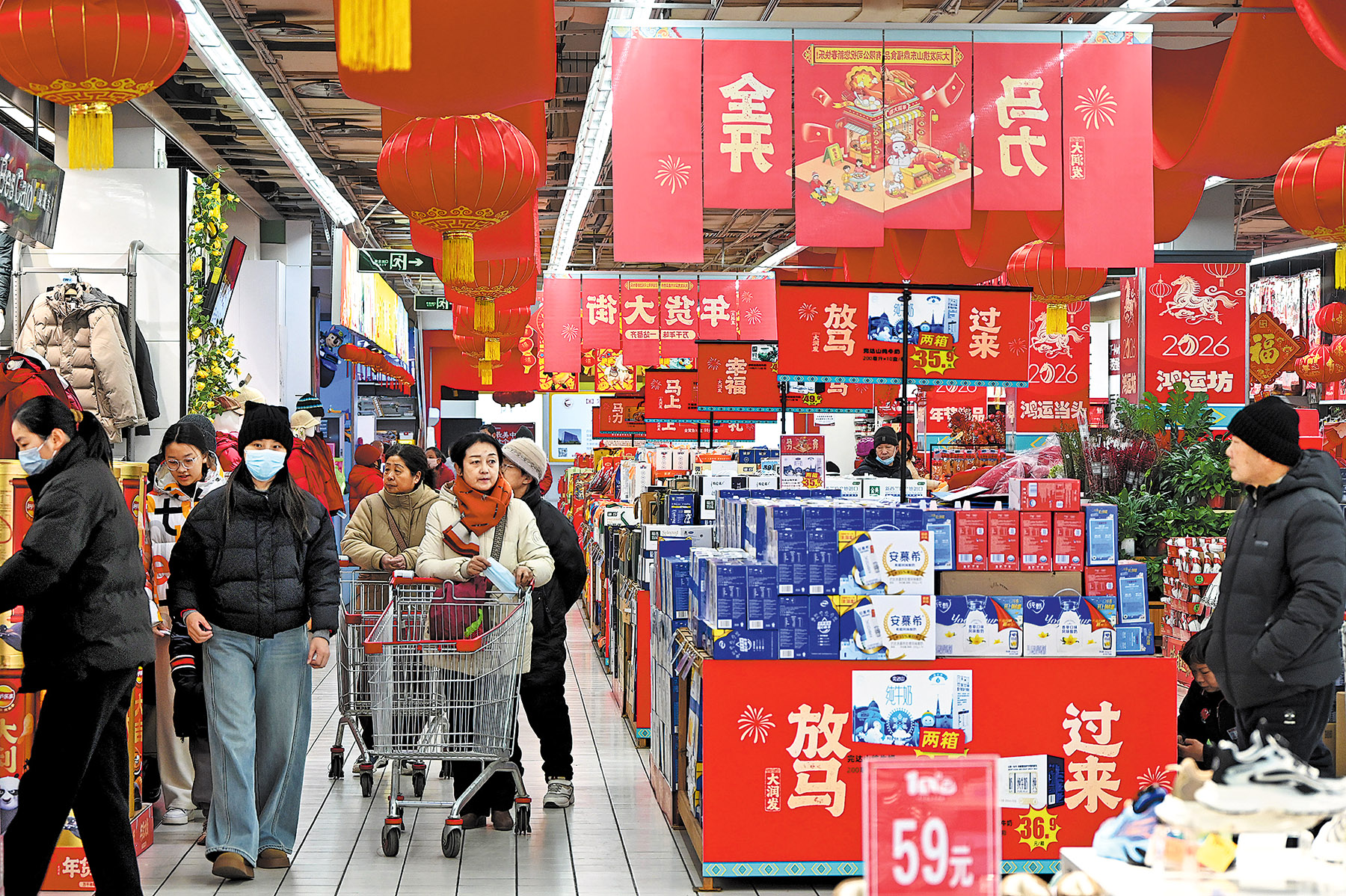
Foreign institutions and global executives are striking a broadly upbeat tone on China’s economy in 2026 and are increasingly confident about new opportunities generated by high-quality growth, citing the country’s economic resilience, strong policy support and faster technology-driven transformation.
Though short-term headwinds persist, they expect China’s economic growth to maintain momentum over the year, with the complete and vast industrial system, improving productivity and ultra-large domestic market as key anchors of stability.
Observers stressed that domestic demand will continue to serve as the main driver of growth, supported by intensified fiscal backing and further monetary easing.
Citing China’s hard-won 5 percent real GDP expansion in 2025 despite extreme external uncertainties, Lu Ting, chief China economist at Japanese financial services group Nomura, said it reflects the strong resilience of the world’s second-largest economy.
Scale effect means size-driven efficiencies that help lower costs and strengthen resilience.
President Xi Jinping stressed earlier this year that it is important to keep the domestic economy as the mainstay, and the quality and efficiency of the national economic flow should be further improved to make domestic demand the main driver of economic growth.
Looking ahead, economists said they expect that fiscal and monetary support — with a rising focus on boosting people’s well-being and vitalizing private sector investment — is set to gradually rectify insufficient domestic demand. This would further consolidate the foundation of robust economic expansion in 2026 and throughout the 15th Five-Year Plan (2026-30) period.
“Fiscal policy will play the leading role in stabilizing growth, including efforts to shore up domestic demand and stabilize the property market,” Lu said, expecting the issuance of more ultra-long-term special treasury bonds and local government special bonds.
To accommodate government bond issuance, Zhang Jun, chief economist at China Galaxy Securities, said that the first quarter may see a cut in the reserve requirement ratio, or RRR, which would reduce the amount of cash banks must hold as reserves and ease liquidity conditions.
Pan Gongsheng, governor of the People’s Bank of China, the country’s central bank, has vowed to “create a sound monetary and financial environment for stable economic growth, high-quality development and the steady performance of financial markets”.
Pan said in an interview with Xinhua News Agency last week that there remains room this year for cuts in interest rates and the RRR, while government bond trading operations will be further utilized to keep the banking system’s liquidity ample.
Indicative of a pro-growth policy stance, the central bank has cut rates on targeted policy tools this month and expanded relevant central bank lending quotas to support private enterprises and technological innovation, while fiscal authorities launched loan subsidies and guarantees to boost investments of smaller businesses.
With policy effects filtering through, Shan Hui, chief China economist at Goldman Sachs, said investment performance this year should improve, driven by projects delayed from 2025 and major initiatives in technology, artificial intelligence and power grids.
Regarding consumption, Shan said growth remains structurally uneven, with services consumption outperforming that of goods. While household consumption is still relatively weak, rising government consumption following easing debt pressures is expected to support overall demand, the economist said.
The solid economic outlook has underpinned multinational companies’ growing confidence in the Chinese market, with French industrial conglomerate Schneider Electric expanding its capabilities here.
Yin Zheng, executive vice-president of China and East Asia operations at Schneider Electric, said its new industrial park in Wuxi, Jiangsu province, will be completed soon, while a newly built industrial park in Xiamen, Fujian province, is scheduled to begin operation in the first half of 2026 as the firm’s largest global production base for medium-voltage products.
“The recommendations for formulating the 15th Five-Year Plan further underscore the development of new quality productive forces and high-quality growth, while once again sending a clear signal of high-level opening-up and mutually beneficial cooperation, providing strong policy impetus for China’s steady economic expansion and efficiency-driven upgrading,” he said.
Contact the writers at ouyangshijia@chinadaily.com.cn
