

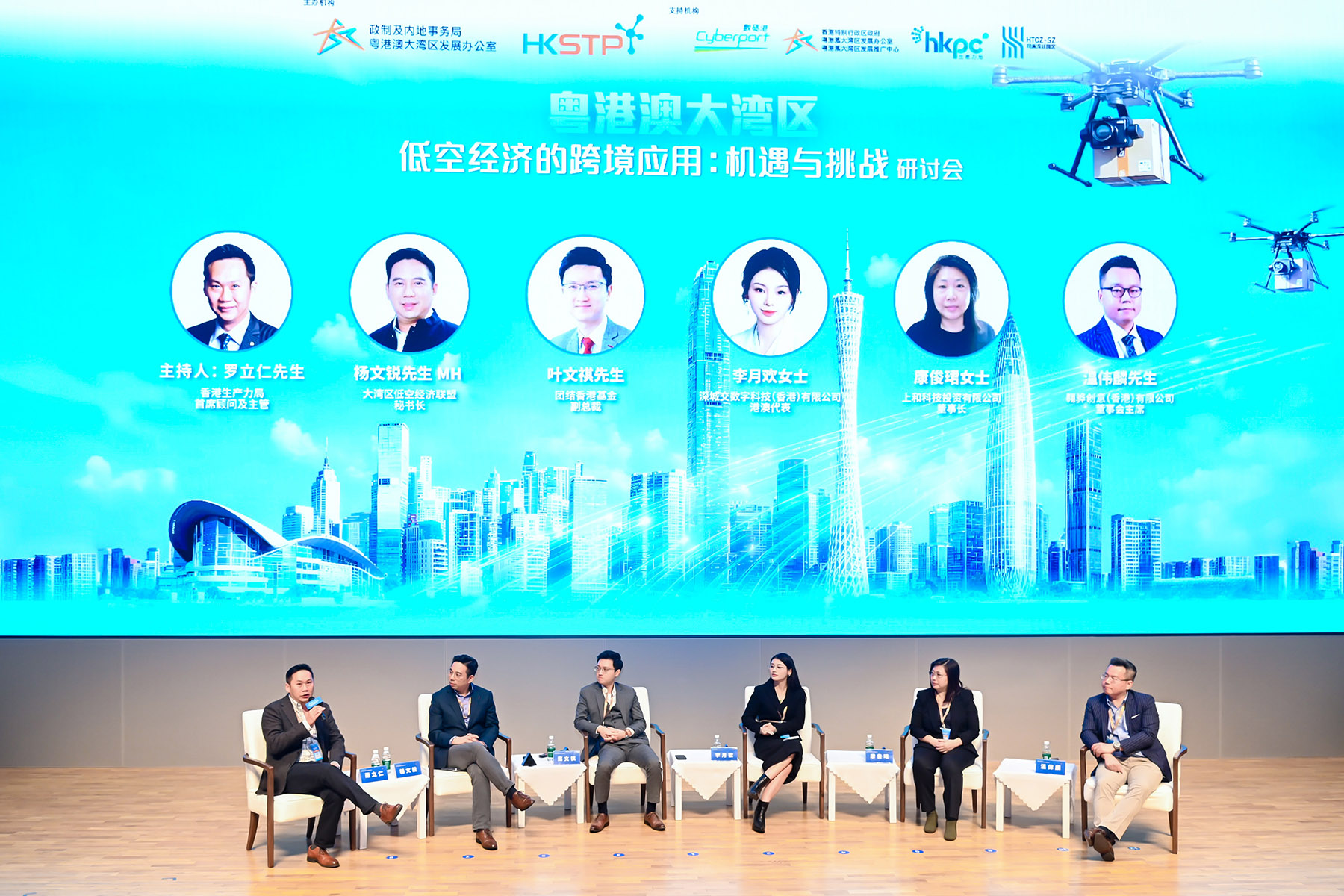
Industry insiders from Hong Kong and the Chinese mainland have called for specific and robust policy support to address the challenges of cross-boundary drone flights and further explore the vast opportunities presented by the low-altitude economy.
During a Tuesday seminar that focused on low-altitude economy cross-boundary applications in the Guangdong-Hong Kong-Macao Greater Bay Area, low-altitude business operators and researchers said that despite huge industry potential, cross-boundary drone transportation still faces multiple challenges related to regulations, technology, and oversight.
Li Yuehuan, a representative from Shenzhen Urban Transport Planning Center Digital Technology (Hong Kong) Limited, said low-altitude vehicles could be an efficient and convenient solution for the significant logistics demands between Shenzhen and Hong Kong. However, their use is hampered by unclear customs policies, lengthy approval processes, insufficient mutual regulatory recognition, and limited landing sites, he added.
As a national leader in intelligent transportation solutions, the planning center is involved in two projects that are among the first pilots of Hong Kong’s low-altitude economy regulatory sandbox. One focuses on logistics between Shenzhen and Hong Kong, while the other addresses the transportation of medical supplies within Hong Kong.
Although both projects were approved early last year, the first project is scheduled for trial flights in late-January, as the company took time addressing challenges associated with cross-boundary low-altitude logistics.
“Currently, there is no single government department overseeing all aspects of low-altitude cross-boundary operations, requiring us to report to and communicate with each relevant party,” Li said, calling for joint support from the industry and the government to address industry pain points and reduce institutional and technical barriers.
In 2026, the planning center will continue to apply for Hong Kong's low-altitude regulatory sandbox projects, one of which focuses on the development of a drone traffic management system. It also plans to participate in low-altitude water management and other scenarios in the future, Li said.
ALSO READ: Forum: Global firms stick with China, look to HKSAR for access and opportunity
Kang Junjun, chairman of Shanghe Technology, a Zhuhai-based digital industry development company with various low-attitude businesses, called on the Greater Bay Area to establish a unified regulatory framework in this field, particularly in areas such as drone classification, insurance, and licensing procedures.
She said she would also like to see the establishment of a collaboration mechanism for the approval of cross-boundary flights, the mutual recognition of regulations, and joint enforcement actions.
Additionally, she is advocating for the interconnection of infrastructure networks and service platforms for cross-border flights, including facilities related to communication, surveillance, and takeoff and landing.
Her company has participated in several innovative low-altitude economy projects, including conducting ultra-low-altitude flight tests between Zhuhai, Macao, and Hong Kong with a large cargo drone at the end of 2024. It also provided low-altitude flight support during the pioneering cross-boundary road events of the 15th National Games.
Gary Yeung, secretary-general of the Greater Bay Area Low Altitude Economy Alliance, encouraged the cluster to issue specific guidelines for cross-boundary drone flights, while calling on Hong Kong to set up a designated bureau to speed up low-attitude economy development.
He also proposed transforming the customs and logistics facilities of River Trade Terminal in Hong Kong’s Tuen Mun into a low-altitude economic logistics transportation center to support logistics operations at Hong Kong International Airport.
