

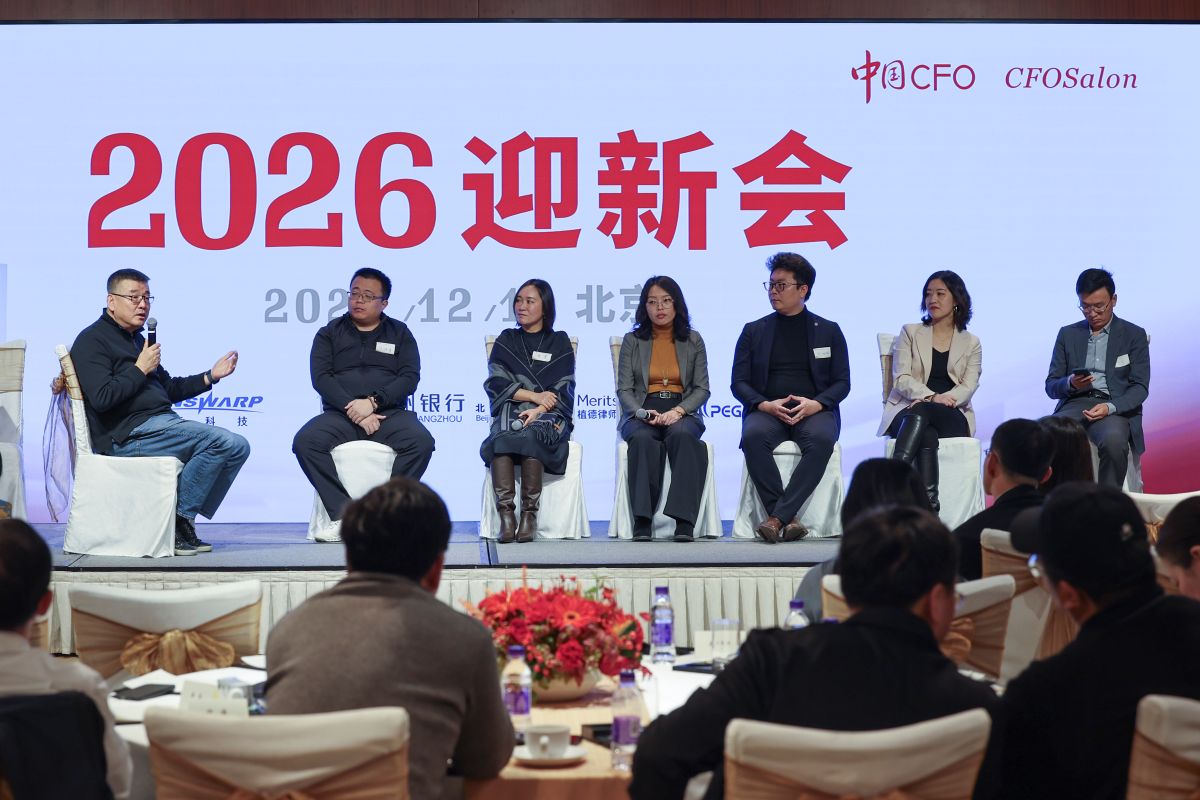
BEIJING — Sixty CFOs and senior investment professionals from leading enterprises across sectors such as AI technology, healthcare, manufacturing, retail, and cross-border trade gathered in Beijing recently for the 2026 CFO New Year Meeting of China CFO book series and the CFO Salon.
Participants engaged in in-depth discussions centered on four key themes: Artificial Intelligence and its Applications, the Big Health Industry, Global Expansion of Chinese Companies, and the Consumer Sector.
They analyzed pressing industry challenges and transformation pathways under the new economic landscape, providing multifaceted perspectives aimed at informing corporate strategic planning and fostering high-quality industry development in the coming year.
AI & applications
With the large-scale implementation of AI technology becoming a central focus of corporate digital transformation, the discussants identified fragmented data and inconsistent quality as common pain points hindering current AI initiatives, leading directly to inefficient model training and subpar output accuracy.
They stressed that the key solution lies in establishing a closed-loop system of "AI-empowered data governance." By deploying AI tools for data classification, cleansing, and validation, companies can solidify the foundation needed for effective AI application deployment.
They noted that scaling AI applications also requires solving industry-wide challenges of high costs and decentralized management.
As AI demands grow increasingly diverse across various business departments, the traditional customized development model not only consumes substantial resources but also leads to redundant investments and management disarray. Therefore, building a unified AI operation and management platform has emerged as a consensus solution, they opined.
Such platforms significantly reduce AI development and operational costs across multiple business lines by integrating heterogeneous computing power, unifying data corpus management, and supporting coordinated multi-model deployment. They also enable standardized technical protocols and controllable data security, serving as a core enabler for the scaled implementation of enterprise AI, according to the discussants.
They highlighted three primary investment themes for 2026: foundational technologies like data governance, labeling, and synthesis, which are essential for AI implementation and represent non-negotiable demand; infrastructure such as computing power and electricity supply, where demand is expected to grow exponentially with the scaling of AI models, presenting long-term value; and vertical application scenarios — including intelligent marketing, process automation, and digital health — where products that demonstrably enhance efficiency or solve critical user pain points will attract sustained capital inflow.
Aligning with national strategies and emerging market opportunities, the global expansion of AI technology and applications was identified as a significant growth vector.

Healthcare industry
Pointing out that the healthcare industry is grappling with both a valuation recovery and deep structural transformation, the discussants said China's healthcare industry has undergone a full cycle over the past decade — from an influx of capital, to a bubble burst, and now to a phase of valuation correction.
While the Chapter 18A market in Hong Kong saw a rebound in 2025, fundraising in the primary market remains challenging, with many companies facing the pressure of high R&D investment versus slow commercial returns.
The long-term development of the industry hinges on balancing a business model characterized by high investment, long cycles, and significant risk with its fundamental social and public welfare role, they said, adding that the core challenge lies in ensuring public welfare while simultaneously providing reasonable profit space for innovative products.
The innovation transformation of traditional pharmaceutical companies emerged as a key focus in the discussions. Generic drug makers are widely facing squeezed profit margins due to centralized procurement policies and shrinking market space, while building an in-house innovative drug R&D system presents challenges of long cycles and high risks.
Consequently, many traditional firms are exploring transformation through avenues such as acquiring R&D pipelines and expanding into markets beyond the hospital setting. While acquiring mature R&D pipelines allows companies to swiftly enter innovative fields, avoiding the risks of starting from scratch, they are actively expanding into diversified channels, including retail pharmacies and online healthcare, seeking new avenues for growth.
The diversified development of niche segments is injecting new vitality into the healthcare industry. Beyond innovative drugs and medical devices, "pan-health" fields such as mental wellness, digital therapeutics, and health-conscious consumption are showing robust momentum. These segments, being closer to the consumer market, can rapidly integrate with digital and AI tools, opening up new growth trajectories.
Pointing out that health needs are multifaceted, the participants said both direct-to-consumer health solutions and technology innovations aimed at enhancing medical efficiency hold equally promising prospects against the backdrop of pressure on the payment side.
Global expansion
Underscoring the need for Chinese enterprises seeking a second growth curve to explore overseas markets, the discussants said the global expansion of Chinese companies has now entered a new stage, with the core discourse evolving from "why go abroad" to "how to gain a firm foothold overseas.”
A significant emerging trend is the shift from traditional product exports toward "systematic globalization," they said, adding that this transition is both a strategic response to the increasingly complex geopolitical and compliance landscapes in markets like Europe and the US, and a natural extension of China's competitive advantages in sectors such as new energy and digitalization.
No longer merely selling commodities, enterprises are exporting integrated solutions encompassing technology, capital, management expertise, and complete supply chains, they said, adding that on the global market chessboard, strategic choices are revealing distinct tiers.
Mature markets like Europe and the US are suitable for deploying consumer goods and premium services, where companies can achieve profitability through product differentiation and brand premium. Emerging markets such as Southeast Asia, the Middle East, and Latin America, which have relatively underdeveloped supply chains and robust market demand, meanwhile, present opportunities for long-term strategic investment, allowing firms to share in the growth dividends alongside local economic development, they said.
Regardless of the chosen path for global expansion, deep localization is widely regarded as the decisive factor for long-term success overseas, the participants said.
Going far beyond merely translating language or adapting products, it requires a fundamental adjustment in a company's operational mindset, they said. Specifically, firms must strictly comply with local regulations concerning labor, environmental protection, and data privacy. It is essential to build localized teams capable of deeply understanding and integrating into local business networks and cultural contexts. Furthermore, contributing to the development of local industries and economies is crucial for gaining local support, they added.

Consumer sector
Following a period of significant adjustment, China's consumer sector witnessed a notable wave of mergers and acquisitions in 2025.
Participants identified two core drivers behind this uptick in M&A activity. Firstly, strategic realignments by foreign brands in the Chinese market have created acquisition and integration opportunities for domestic companies. Secondly, as the domestic market shifts from "competition for growth" to "competition for market share," the operating space for small and medium-sized enterprises continues to shrink.
Leading players are increasingly turning to acquisitions to expand their market share and build out more comprehensive product portfolios. Looking ahead, this trend is likely to further solidify a market landscape where the strong get stronger, they said.
Pointing out that consumer demand is evolving with distinct characteristics: stratification, rationalization, and occasion-driven spending, the participants said the current market does not simply reflect a consumption downgrade. Instead, consumers are becoming more discerning — unwilling to overpay for brand premiums, yet still valuing product quality, experience, and emotional satisfaction.
Meanwhile, consumer groups and usage scenarios are increasingly segmented. The personalized needs of younger generations, the health-focused demands of middle-aged and elderly groups, and the scenario-specific requirements of family consumption are collectively driving products and services toward greater diversification. In response, companies must pinpoint these nuanced differences across consumer segments and implement more granular operations.
They stressed that companies must uphold core fundamentals while pursuing innovation to address intense market competition.
They agreed that the consumer sector's ultimate competitive edge always lies in the product itself — regardless of marketing innovations, product quality remains the essential foundation. Therefore, firms must first adhere to "product supremacy," enhancing R&D capabilities and optimizing supply chain management to ensure both quality and cost-effectiveness.
They should also advance digital transformation, leveraging big data and AI tools to comprehensively analyze consumer demand, refine user experience, and accurately identify new growth opportunities, the discussants said. Businesses need to expand their growth horizons by penetrating lower-tier markets to tap into new demand and extending product categories to serve a full age spectrum of customers, thereby avoiding over-reliance on any single product or consumer group.
The CFO New Year Meeting concluded on a note of substantive and forward-looking dialogue. Participants broadly agreed that 2026 will remain a year of both significant opportunities and complex challenges.
In the face of profound transformation driven by AI and ongoing adjustments in the global landscape, they highlighted that maintaining strategic focus, persisting with innovation-led development, and skillfully seizing opportunities amidst uncertainty are essential for steering enterprises toward sustainable growth and collectively forging a new chapter of high-quality development.
