

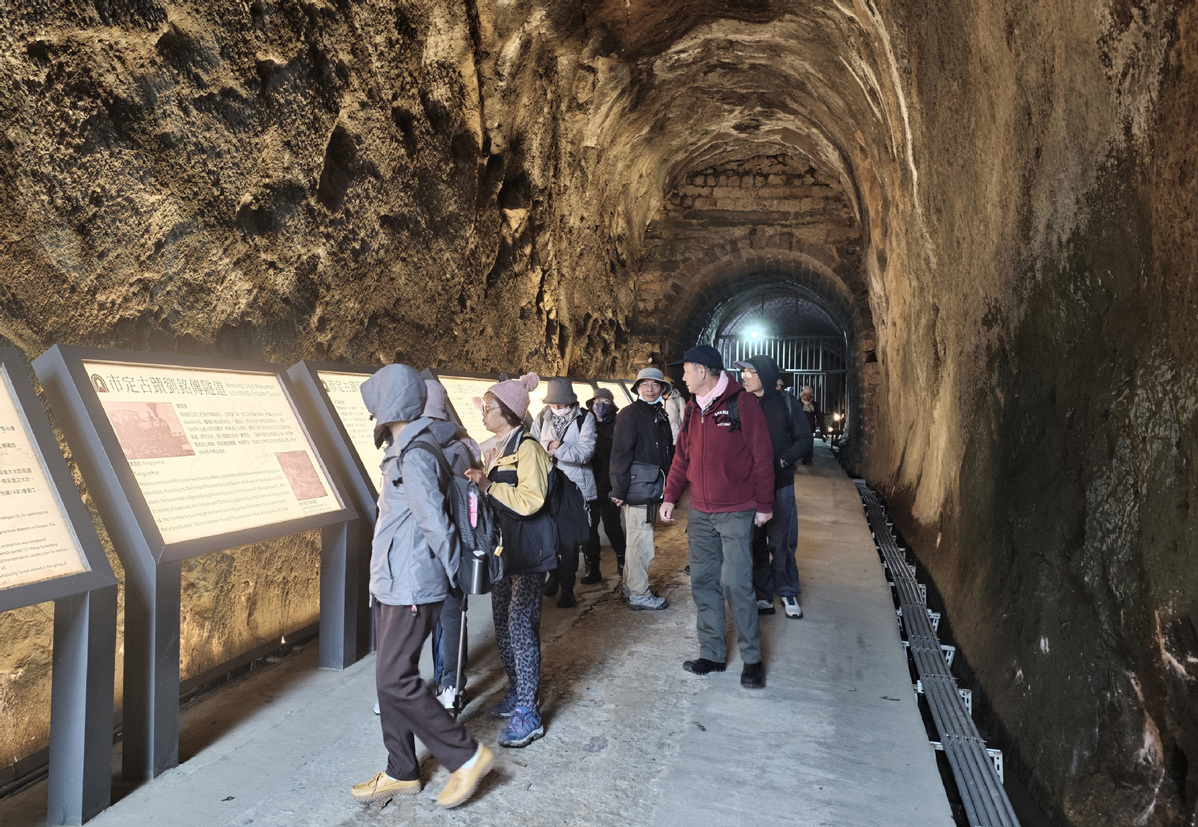
TAIPEI -- Located in Keelung in northern Taiwan, the Shiqiuling Tunnel spans 235 meters in length -- yet over a century ago, its construction required approximately 30 months of labor.
Recently reopened to the public for free visits, the tunnel is widely known as the "Liu Mingchuan Tunnel" -- named after the first governor of Taiwan in the Qing Dynasty (1644-1911), who oversaw its construction.
As the first railway tunnel in Chinese history and Taiwan's only surviving railway tunnel from the Qing Dynasty, the tunnel had been closed for years before undergoing recent restoration.
"We knew this area was off-limits to outsiders in the past, and when we saw online that it had been opened, we decided to come back to have a look," said a visitor surnamed Lin, who visited with his wife. Both are now retirees living in Taipei but had previously lived in Keelung for decades.
"We learned about Liu's achievements from the textbooks when we were young and knew that he did many practical things for Taiwan," Lin said.
ALSO READ: Mainland refutes comparison between Taiwan and Venezuela
At the northern entrance of the tunnel, several panels have been installed that introduce the tunnel's history and provide details about its construction through text, photographs and diagrams.
In 1885, Taiwan was established as a Chinese province, and Liu, who had arrived at the island in the previous year and led the defense of Taiwan against French forces in the Sino-French War, became its first governor.
Liu was a supporter of the Self-Strengthening Movement, which was initiated by some Qing officials to strengthen China's military and industry by adopting Western technologies. One of his endeavors to develop Taiwan was to build railways, a proposal approved by the Qing court in April 1887.
As a crucial link on the planned railway between Taipei and Keelung, tunnel construction commenced in the spring of 1888 amid great difficulties, as it traversed interlaced sandstone and shale layers.
"Liu's decision to build railways in Taiwan was highly forward-looking, and it also came at a tremendous cost," said Chi Chia-lin, a Taiwan historian, noting that many soldiers from the mainland lost their lives during the construction.
READ MORE: Compatriots across Taiwan Strait urged to promote national reunification
The tunnel was completed in 1890. In the following year, the 29-kilometer railway section from Taipei to Keelung officially opened to traffic. In the same year, Liu resigned as Taiwan's provincial governor under pressure from the Qing court and departed the island.
According to Chi, Liu's greatest contribution to Taiwan was his drive to promote modernization on the island, including not only building railways but also installing telegraph lines and establishing arms factories. Liu has been widely regarded as the founder of Taiwan's modernization.
"His achievements benefited Taiwan and modern China in general," Chi said.
"In Taiwan, there is probably no one who does not know the name of Liu Mingchuan," Lin said. "But younger people may no longer care much about that part of the history. I hope more people can learn about Liu's contributions from here."
