

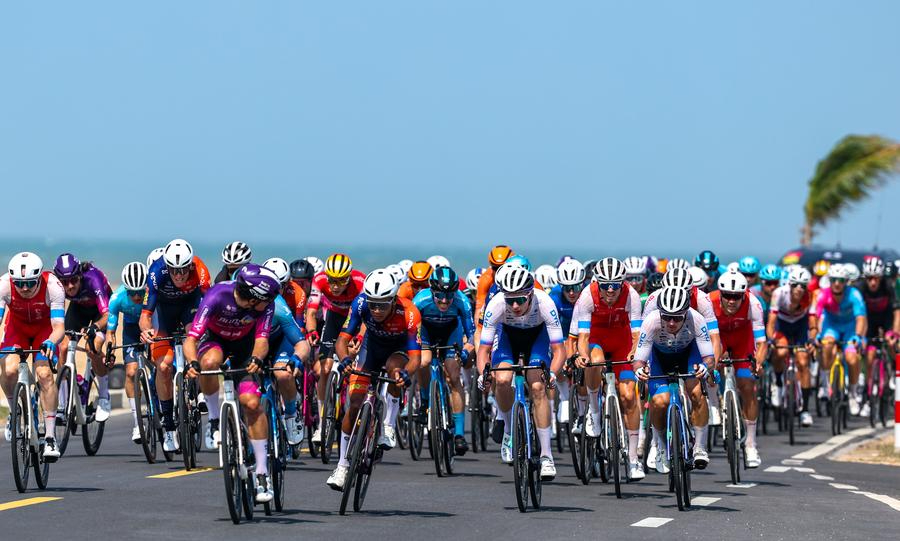
BEIJING -- Whether traversing the breezy coastal greenways of Shenzhen, a coastal city in southern China, or "looping" the 100-kilometer urban parkway in Chengdu, renowned as a "leisure city", cycling has emerged as a vibrant lifestyle choice, a social gathering hub, and a key driver of China's burgeoning outdoor economy.
According to an industry report on outdoor sports released by the General Administration of Sport, China's bicycle industry achieved a total output value of over 300 billion yuan (about $42.9 billion) by the end of 2024. Notably, sales of sports bicycles and smart e-bikes surged by 18 percent and 25 percent year-on-year, respectively.
From infrastructure to lifestyle
In Shenzhen, where half is mountain and sea, half is city, a 260-kilometer coastline serves as a scenic backdrop for cycling enthusiasts.
"The government has actively incorporated feedback from the cycling community to develop a more professional and accessible path system," said Pan Yong, president of Shenzhen's cycling association. The city aims to complete a leisure cycling network exceeding 1,000 kilometers by 2035.
Meanwhile, in Chengdu, the 100-kilometer round-the-city greenway has evolved into a legendary "cycling loop."
ALSO READ: Growing health awareness feeds new 'slimming economy'
Zhang Yu, a local cyclist outfitted with professional gear, usually dedicates six hours on weekends to completing the full loop. "It's an ideal way to unwind while immersing oneself in the scenery," Zhang said.
With a cycling population exceeding 2 million and daily shared-bike rides surpassing 2.2 million, the highest in the country, Chengdu's sports consumption is experiencing explosive growth. In the first half of 2025 alone, the city's sports-related spending, fueled by cycling, is projected to hit 41 billion yuan.
A 'social magnet' for consumption
Cycling is no longer just about the bike; it is about the community. In Shenzhen, cycling paths now link major business districts, parks, and cultural landmarks, fostering vibrant "stay-and-spend" hotspots.
"A cycling park is a destination for social engagement," said You Fangfang, a brand planner at Kaledo. The brand's "Corner Cycling Life Festival" in the Greater Bay Area has attracted up to 60,000 visitors per weekend, blending cycling with coffee culture, rock climbing, and pet-friendly activities.
READ MORE: Young Chinese show growing interest in outdoor activities
The trend has also captivated global attention. After retiring, world champion cyclist Wong Wan-Yiu relocated to Shenzhen's Yantian district, where she started a bike motocross club.
"I live right by the sea," Wong said. "My Hong Kong friends often come to Shenzhen for weekend rides, and many young riders from Hong Kong join our club for training sessions."
To bridge the "last kilometer" for riders, Shenzhen has launched dedicated "cycling buses" and "bike-friendly" subway trains, enabling enthusiasts to transport their bicycles directly to the start of scenic routes.
From 'gear up' to 'smart tech'
The cycling craze has directly spurred a shift from basic utility to professional performance. Li Junshang, head of cycling community operations at Decathlon Shenzhen, noted that consumers are increasingly "choosing equipment based on specific needs."
READ MORE: Outdoor sector seen taking off nationwide
"Sales of folding bikes have surged by 30 percent year on year, while demand for children's bikes and touring models continues to grow steadily," Li said. "Cycling is now an integral part of diverse lifestyles, from commuting to parent-child outings and outdoor exploration."
This growing demand is fueling high-tech manufacturing. Dahon, a leading folding bike manufacturer headquartered in Shenzhen, holds over 600 patents.
"Our growth demonstrates that 'small wheels' can indeed propel a big industry," said David T. Hon, an 80-year-old laser physicist and chairman of Dahon. He attributed the company's expanding business to the government's emphasis on innovation and intellectual property protection.
As the industry matures, experts believe the "cycling economy" is shifting from a price-driven to a value-driven model. The bicycle is no longer merely a means of transportation; it has become a catalyst for innovation, a cultural symbol, and a gateway to a new lifestyle.
