

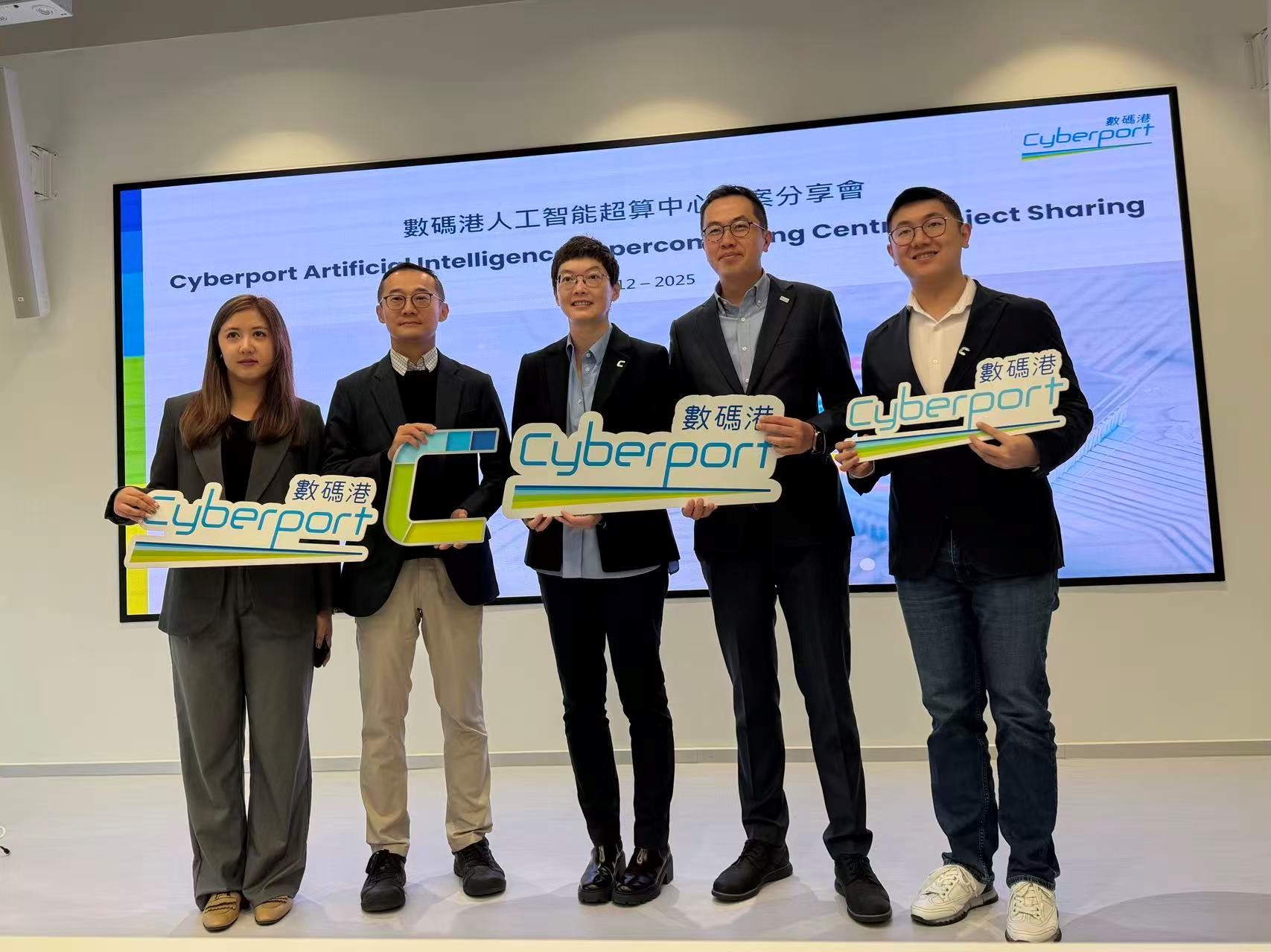
Hong Kong companies deploying artificial intelligence said on Tuesday that access to the city’s largest AI supercomputing center has supercharged their research and operations, thanks to its massive computing power, lower barriers to entry and international security standards.
Since coming online in December last year, the AI Supercomputing Centre located at Hong Kong’s digital hub Cyberport has been an important driver of the city’s technological progress, supplying high-end computing resources to universities, research institutions, and industry players.
Ricoh Hong Kong Ltd, a workplace technology provider, said after tapping the facility’s services, response times for large language models were reduced by 40 percent, while efficiency in handling complex queries improved by 25 percent.
ALSO READ: Report: Hong Kong leads globally in AI preparedness
Inference costs, namely the computing resources and expenses required for each user request, dropped by about 30 percent, said Vincent Leung, the company’s head of presales specialist. Service reliability and stability also improved, as data is fully processed within Hong Kong, eliminating the risk of disruptions previously associated with cross-border data handling.
Pivotal Technologies Ltd, which uses AI to generate visual content such as videos, virtual influencers and KOL for its clients’ marketing and promotional purposes, also benefited from the enhanced computing power.
Video resolution has improved, generating time has been cut by more than half, and the ability to produce four videos simultaneously has boosted overall efficiency by about 75 percent, said senior product manager Pedro Ng.
READ MORE: Inaugural Hong Kong AI Art Festival opens: Will AI replace artists?
The supercomputing center offers data security and privacy protection that meets international standards — often one of the biggest concerns for corporate users, said Ronald Cheng, director of operation at KBQuest. The digital transformation consulting firm offers AIEN Chat, an enterprise-grade private AI assistant platform designed to enhance office productivity.
Now operating at around 80 percent of its capacity, the center provides 3,000 petaflops of computing power, enough to process nearly 10 billion images in an hour, complete more than 11 million hours of voice translation, and handle AI data for over 40,000 kilometers of autonomous driving. This has lifted Hong Kong’s total computing capacity to 5,000 petaflops.
Since the Hong Kong Special Administrative Region government opened applications for the HK$3 billion ($390 million) Artificial Intelligence Subsidy Scheme in October 2024, the program has received more than 30 applications, with nearly 20 projects led by local universities and research institutes securing approvals so far, said Crystal Fok, head of business development at Cyberport.
READ MORE: HK launches HK$500m AI scheme to support schools
She added that the projects cover a wide range, including the development of home-grown large language models, advanced materials, and medical models designed for cancer screening. They started using the supercomputing center from January this year, with each of them able to receive funding up to 70 percent of approved costs.
The subsidy program aims to position Hong Kong as an AI hub, Fok said, noting that all industries are encouraged to leverage these resources to achieve technological and digital transformation, and deliver tangible benefits to the public.
Besides supporting projects at more advanced stages of development, Cyberport earlier this year launched the AI Special Scheme to support innovative ideas at an infant stage. Approved projects are allowed to access the supercomputing power for a minimum monthly charge of HK$1,800. It has received nearly 30 applications so far, with more than 20 projects already participating.
The special program will be integrated into the Hong Kong government’s Artificial Intelligence Subsidy Scheme in future, so as to expand the scope of support, according to Cyberport.
Contact the writer at irisli@chinadailyhk.com
