

Investment banks are on track to take home their smallest slice of underwriting fees from Hong Kong listings in years, even as share sales in the city have staged a blistering rebound.
Companies going public in the city paid banks an average base fee of 1.5 percent of the money raised, excluding incentives, the lowest since at least 2000, according to capital-markets data provider LSEG. That compares with an average of 2.3 percent over that quarter century and with a rate of 2.4 percent across the Asia-Pacific region this year. The final figure may shift as some deals are yet to price this month.
The main reason: A surge in second listings by companies already trading on Chinese mainland exchanges. Such deals — often called A-to-H listings — typically pay far less than standard initial public offerings. This year they’ve paid an average base fee of 0.9 percent, compared with 2.2 percent for standard IPOs.
ALSO READ: Hong Kong asks banks to ensure IPO applications maintain standards
Some of the Hong Kong Special Administrative Region’s biggest deals this year have been A-to-H, like Shenzhen-listed battery giant Contemporary Amperex Technology Co Ltd’s $5.3 billion share sale — the world’s second-biggest listing of 2025. It paid just 0.2 percent in base underwriting fees and 0.6 percent in incentive fees.
Fees were also dragged down by intense competition among bankers, hungry for deals after a multiyear drought.
“Lower fees tell you that it’s a carnivorous, competitive business, and issuers are sophisticated in negotiating down underwriting fees,” said Craig Coben, a veteran investment banker who was one of Bank of America Corp’s most senior capital markets executives until he retired in 2022.
Bankers say they view A-to-H listings as more akin to share placements of already-listed companies, which tend to pay less than IPOs, given the record of disclosures that can be readily repurposed for roadshow materials.
ALSO READ: Hong Kong’s IPO market to reach HK$320b in 2026, accounting firm says
“We are seeing some fee compression in the Hong Kong market,” said Gaetano Bassolino, co-head of global banking for Asia Pacific at UBS Group AG. “However, the high volumes this year have more than offset it.”
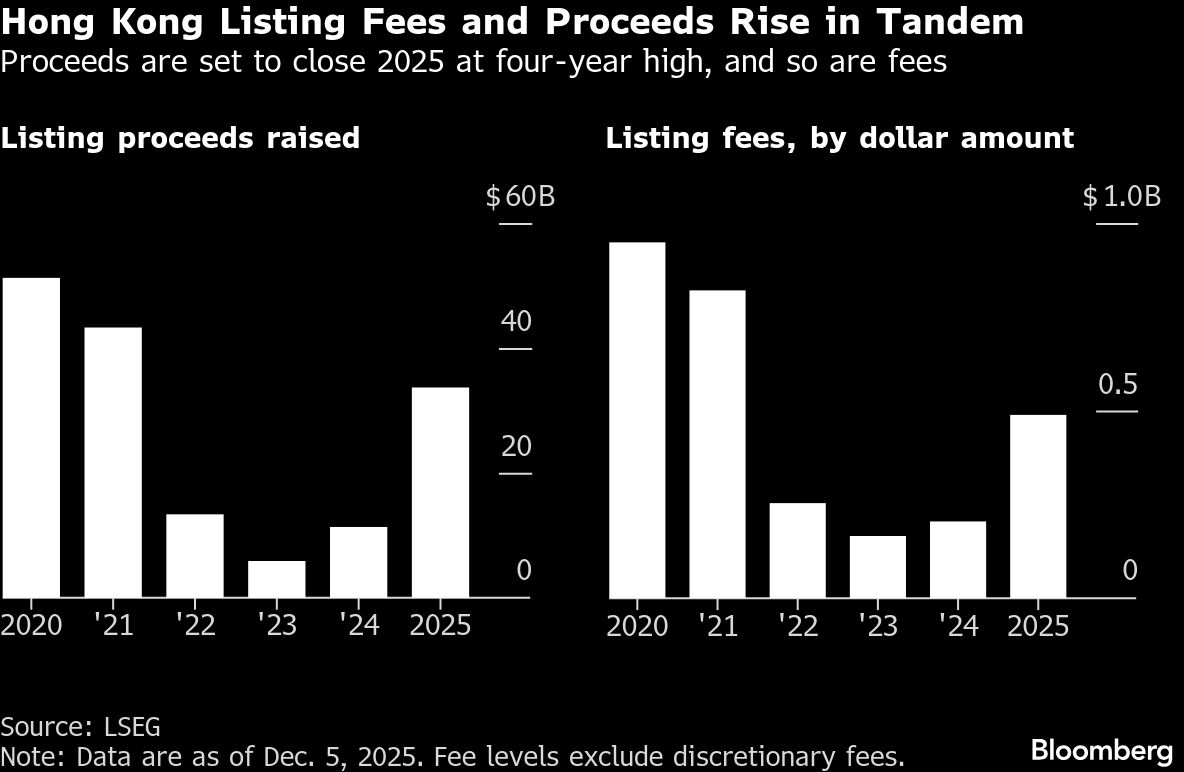
While fee rates fell, the dollar amount banks earned from Hong Kong listings this year has still risen along with overall deal volumes. The listings have generated $489 million of fees in 2025, on track for their highest since 2021, LSEG data show. Those numbers exclude the 1 percent brokerage fees charged to investors and any incentives companies may have paid on top of the base.
“It’s a hugely important market,” Coben said. “It can be lucrative, but you have to work hard and deliver for some very sophisticated and demanding clients.”
A turnaround may be coming, though. Bankers expect more standard IPOs next year, raising optimism for a rebound in fee rates as well. The booming overall pipeline means banks may be less inclined to cut fees to win business.
READ MORE: HSBC predicts Hang Seng Index to reach 31,000 by end of 2026
And it still makes sense for Wall Street banks to pursue blockbuster deals, even with the current levels, said Veronique Lafon-Vinais, a former investment banker of more than two decades who’s now teaching at Hong Kong University of Science and Technology’s business school. The listing mandate may later bring more business, such as wealth management for the companies’ founders, she said.
“It’s the harsh reality,” she added.
