


MOSCOW - China and Russia agreed on Tuesday to fully implement the important consensus reached between the two heads of state on strategic security and advance bilateral strategic coordination toward higher quality.
The agreement was reached at a meeting between Wang Yi, a member of the Political Bureau of the Communist Party of China Central Committee and director of the Office of the Central Commission for Foreign Affairs, and Sergei Shoigu, secretary of the Security Council of the Russian Federation.
Wang and Shoigu co-chaired the 20th round of China-Russia strategic security consultation, during which the two sides conducted comprehensive and in-depth communication on major issues involving the strategic security interests of both countries, reached new consensus, and strengthened strategic mutual trust.
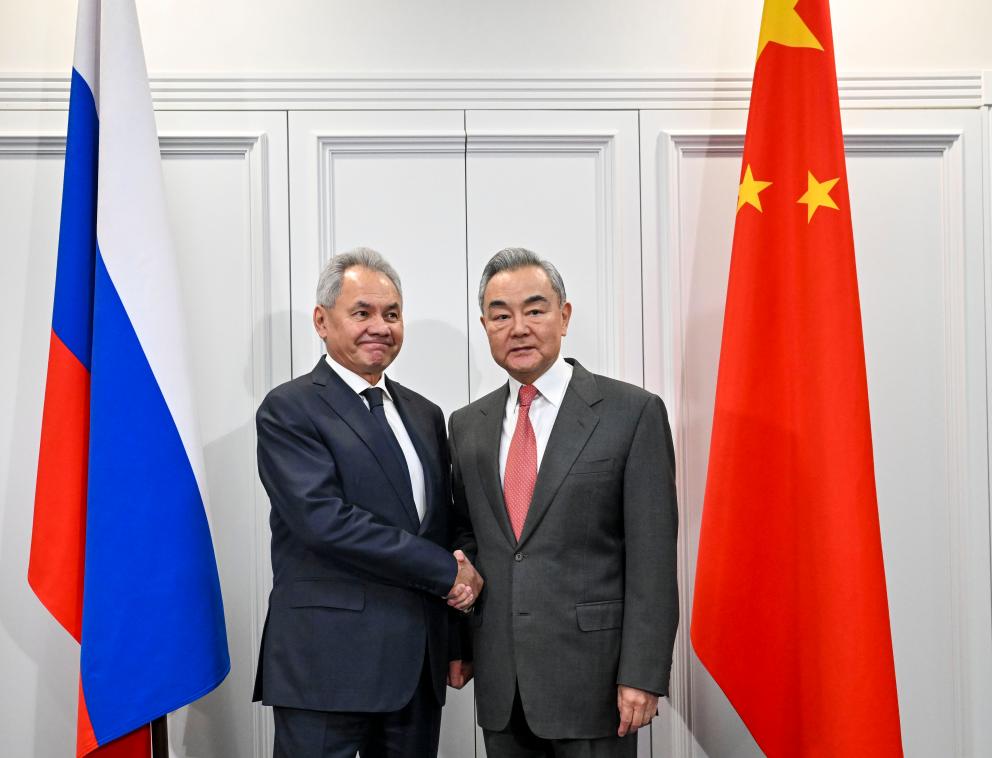
Wang noted that China-Russia relations have achieved high-level development this year. In particular, Chinese President Xi Jinping and Russian President Vladimir Putin met twice this year, once in Moscow and once in Beijing, providing guidance for the steady development of bilateral relations amid a complex and changing environment, he said.
Next year marks the 30th anniversary of the establishment of the China-Russia strategic partnership of coordination and the 25th anniversary of the signing of the China-Russia Treaty of Good-Neighborliness and Friendly Cooperation, and is an important milestone in the development of China-Russia relations in the new era, Wang noted.
He said the two sides should consolidate strategic mutual trust, deepen good-neighborliness and friendship, and expand mutually beneficial cooperation to serve their respective economic development and national rejuvenation, jointly address emerging threats and challenges, and better safeguard global fairness, justice, peace and stability.
ALSO READ: Wang Yi to travel to Russia for 20th round of China-Russia strategic security consultation
Wang noted that the China-Russia strategic security consultation mechanism is an important channel for the two countries to engage in in-depth communication on major issues concerning international security and strategic stability, and an important platform for strategic coordination to safeguard the core interests of both sides.
Over the past 20 years since its establishment, the mechanism has played an active role in implementing the important consensus of the two heads of state, serving the strategic decision-making of both countries, and enhancing political mutual trust, he said, adding that under current circumstances, its value and significance have become even more prominent.
Wang urged both sides to continue to make full use of the mechanism, strengthen strategic communication and coordination, and jointly respond to external challenges.
Shoigu said Russia and China need to strengthen strategic alignment as the international geopolitical landscape is undergoing complex changes and global security challenges are increasing.
Russia-China strategic coordination is at an unprecedented high level, which is in line with the national interests of both countries and benefits regional and global peace, Shoigu said.
He noted that Russia firmly adheres to the one-China principle and strongly supports China's positions on Taiwan, Xizang, Xinjiang and Hong Kong. Russia is willing to work with China to implement the consensus of the two heads of state, intensify bilateral cooperation, and jointly promote the establishment of a more just and reasonable multipolar world, Shoigu added.
READ MORE: Xi calls for consolidating Sino-Russian partnership in energy
The two sides conducted strategic alignment on issues related to Japan, reaching a high degree of consensus. They agreed to resolutely uphold the outcomes of World War II victory, firmly oppose any attempts to whitewash colonial aggression, and resolutely counter any attempts to revive fascism or Japanese militarism. They stressed that China and Russia, as major countries and permanent members of the UN Security Council, will shoulder their shared responsibility to safeguard world peace and security, as well as historical truth and international justice.
The two sides held in-depth exchanges on the Ukraine crisis. Shoigu explained Russia's positions and considerations, and expressed appreciation for China's efforts in support of peace. He said Russia has the full capability and strong determination to achieve its strategic objectives and eliminate the root causes of the crisis.
Wang explained China's consistent stance, stating that China supports all efforts conducive to achieving peace, supports reaching a comprehensive and lasting peace agreement, and will continue to maintain strategic communication with the Russian side on this matter.
The two sides also had in-depth communication and coordinated positions on other international and regional issues of mutual concern, including the maintenance of global strategic stability, major-country relations, and the situation in the Asia-Pacific and neighboring regions, and reached broad consensus.
Safeguarding outcomes of WWII victory
On the same day, Wang also met with Russian Foreign Minister Sergei Lavrov, calling for safeguarding the outcomes of World War II (WWII) victory.
Wang noted that the two sides agreed to firmly uphold the outcomes of WWII victory, resolutely oppose any retrogressive acts attempting to whitewash colonial aggression, and call for upholding justice and fairness.
As permanent members of the UN Security Council and comprehensive strategic partners of coordination for a new era, China and Russia should continue to coordinate and cooperate to resolutely curb the provocative acts of Japan's far-right forces that undermine regional peace and stability and attempt to remilitarize, Wang said.
Russia's visa-free policy for Chinese citizens is a vivid manifestation of the China-Russia comprehensive strategic partnership of coordination for a new era, and will further facilitate personnel exchanges between the two countries and promote exchanges and cooperation in various fields, Wang said.
Noting that next year marks the 30th anniversary of the establishment of the China-Russia strategic partnership of coordination, as well as the 25th anniversary of the signing of the China-Russia Treaty of Good-Neighborliness and Friendly Cooperation, Wang said that the development of China-Russia relations will usher in new historical opportunities.
Lavrov said the two heads of state exchanged visits this year, injecting new impetus into further consolidating the Russia-China comprehensive strategic partnership of coordination.
He reaffirmed that Russia abides by the one-China principle and firmly supports China's position on the Taiwan question.
Russia is ready to take the 25th anniversary of the signing of the Russia-China Treaty of Good-Neighborliness and Friendly Cooperation next year as an opportunity to intensify high-level exchanges, deepen practical cooperation, enhance personnel exchanges, and achieve win-win results, Lavrov said.
The two sides also held an in-depth exchange of views on other international and regional issues of mutual concern.
