

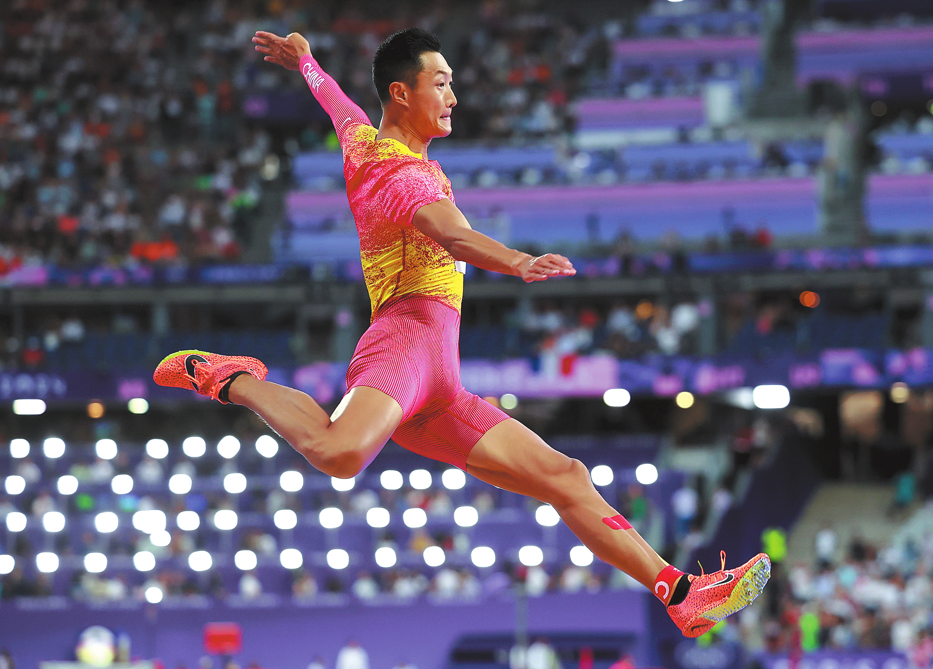
In the men's long jump final at the recently concluded National Games in Guangzhou, defending champion Wang Jianan was nowhere near the runway.
Instead, the 29-year-old world champion sat quietly in the stands, watching others accelerate, rise and fall — movements that have defined his life for more than a decade.
A day earlier, Wang had announced on social media that he would not compete. He underwent surgery earlier this year after an injury, and despite months of rehabilitation, he has not yet returned to competition.
For an athlete who has built his identity on soaring beyond limits, stepping aside was perhaps his biggest test.
"The National Games mean a great deal to me," he wrote.
It is the stage where he has repeatedly proven himself, and the place where he hopes to repay the people who stood behind him.
Though temporarily sidelined, he promised he would continue recovering and work toward returning to the arena next year.
Many fans have been waiting for the moment he takes off again. Wang has been waiting for it, too. But, as he acknowledged, competitive sport is not dictated by will alone. The body demands time — and respect.
The long jumper has experienced highs and lows throughout an athletic career spanning more than a decade, gradually maturing both technically and mentally. Leaving the field due to injury is not the end for him — he still hopes to jump even further.
Taking flight
His absence today contrasts sharply with the journey that began more than a decade ago. Born in 1996 in Shenyang, Wang was fast and powerful long before he knew what those qualities meant. A primary-school sports meet led to his recruitment by a track coach, and curiosity drove him into the decathlon, where he trained across 10 events rather than choosing just one.
His first breakthrough came in 2012, just after his 16th birthday, when he jumped 8.04 meters to win the national championship. It was his first time clearing the eight-meter mark — a distance that would still earn a silver medal at this year's National Games.
A year later, as he shifted to specializing in long jump, Wang crossed paths with Randy Huntington, the then newly appointed American coach of China's national long jump team and a legendary figure who once guided world record holder Mike Powell.
Wang was selected into Huntington's newly formed long jump squad, beginning a partnership that has lasted more than 10 years.
From the run-up, to takeoff and aerial technique, every movement was carefully shaped by Huntington. "Between every jump, he would emphasize the precision of my approach and rhythm," Wang said.
Since 2014, Wang has jumped over 8.10m every year, including tying the national record of 8.47m in 2018, as his best mark steadily improved.
Under Huntington's guidance, Wang soon made his international breakthrough — at the 2015 World Championships in Beijing, the 19-year-old won bronze, the first World Championships long jump medal in Asian athletics history. In an unprecedented achievement, China fielded three finalists in the men's long jump, something only seen previously from the United States at its peak.
Wang continued to climb. At the 2016 Rio Olympics, he finished fifth. In 2018, he came within a centimeter of the Asian record, and in 2020 posted the world's best mark of 8.36m.
But expectations can weigh more than medals.
At the Tokyo Olympics, he jumped only 7.81m in qualification and missed the final.
Long jump is highly unpredictable with little room for error. In some events, competitiveness may help athletes perform better, but in long jump, it can become a burden.
Before Tokyo, his desire to medal became a psychological weight. The extraordinary hunger for victory affected his training. Looking back, he feels he was impatient and anxious, and communication with Huntington suffered, leading to disagreements.
Runway return
Resetting mentally, Wang rebuilt patiently — and the payoff came in 2022.
At the World Championships in Eugene, Oregon, he claimed gold with his final attempt of 8.36m, becoming the first Chinese man to win a world title in a field event.
After winning, Wang ran to the sidelines with tears in his eyes and embraced Huntington.
"My relationship with him is more like father and son. When I was younger, I would argue with him," Wang said. "Before Tokyo, I sometimes lost my temper. After Tokyo, whatever he said, I listened… I just followed his lead."
Hayward Field in Eugene is a lucky place for him — in 2014, he won the World Junior Championships there. It is also Huntington's home ground — the stadium belongs to the University of Oregon, his alma mater.
Right after the competition, Wang rewatched his final jump, analyzing its flaws with Huntington — the run-up and takeoff connection were solid and reflected their training goals, but his aerial technique and landing still had room to improve.
"This gold medal gives confidence to the future of long jump and young athletes," Wang said at the time.
"Kids in the future will face training and competition with a more positive and optimistic mindset."
Becoming world champion did not stop him.
In 2023, he defended his Asian Games title in Hangzhou, Zhejiang province, despite an ankle injury that sent him back to Beijing for treatment shortly before the competition. He returned to the runway to secure gold for the Chinese team.
At the Paris Olympics in 2024, then considered a veteran in his third Olympics appearance, Wang finished eighth — disappointed but determined to move forward.
"It's a pity I didn't perform well and couldn't show my true level. Step by step — there will be more chances," he said.
A brief interruption followed last November, when an out-of-competition test returned a positive result, but the Athletics Integrity Unit later confirmed it was caused by passive inhalation.
The China Anti-Doping Agency announced Nov 24 that Wang bore no fault or negligence, stating he inadvertently inhaled terbutaline particles in the air while accompanying a family member who was receiving nebulizer treatment.
An injury early this year kept him off the field for nearly the entire season, and he missed the chance to defend his National Games title.
Still, the years have reshaped him. The athlete who once pushed impatiently toward results now speaks of renewal, understanding and patience.
The long jump, after all, is a discipline defined by paradox: explosive force built on precision and risk built on restraint. Its finest performances often belong to those who can wait for the right moment to leap.
In 2027, the World Championships will return to Beijing's Bird's Nest — the stadium where Wang won his first worlds medal in 2015. He hopes to stand there again, this time not as a rising star or returning champion, but as an athlete still pursuing distance, still listening to his body and still believing there is further to go.
