

Western sanctions, politicization of aid hamper response, observers say
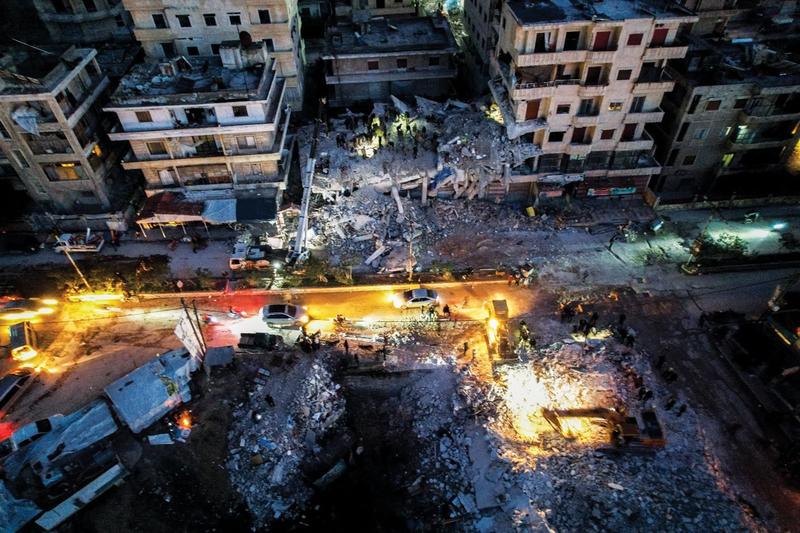 Drone footage of the twin quakes’ massive destruction in Jindaris, Syria, taken on Feb 8 by the media team of Watan, a civil society organization. (PHOTO PROVIDED TO CHINA DAILY)
Politicization of aid and Western-led sanctions have led to snail-paced response to earthquake-hit northwestern Syria, with challenging weather conditions and impassable roads compounding the problems for relief efforts, observers said.
Kinan Diab, coordinator of the Voices for Displaced Syrians Forum, which gathers over 40 Syrian civil society organizations operating in Syria and refugee-hosting countries like Lebanon, Jordan, Turkiye and Iraq, said “the level of delay in response by the international community was unprecedented” in regard to Syrian disaster relief.
Syrians in the northwest “were already struggling with over 10 years of war when the earthquake struck”, he noted.
Some people were yet to have their loved ones buried when two fresh quakes struck the region this week, and the freezing weather is “not helping at all”, especially for families with children who have been protecting themselves “from the war, collapsing buildings, and freeze bites”, said Diab, who is based in the United Kingdom.
He said that some Syrian non-governmental organization workers “are sleeping in their cars”.
“I’ve had coordination meetings with staff calling me from shelters, mosques and cars. I asked a colleague to print a report draft, and he kept telling me he couldn’t find a working printer after their offices collapsed,” Diab said.
Two fresh temblors jolted southern Turkiye and northern Syria late on Feb 20, two weeks after powerful quakes destroyed countless buildings and killed tens of thousands of people in the region.
To date, more than 46,000 people have died in Turkiye and Syria since twin 7.7 and 7.6-magnitude earthquakes struck the region on Feb 6.
The UN estimates that over 6,500 have been killed and 10,000 people injured in all areas of Syria and expects the numbers to rise in the coming weeks as relief operations continue.
Hassan Jenedie, executive director at Bousla Development and Innovation, a non-profit organization based in Turkiye, told China Daily that in both Turkiye and Syria, there have been deaths, injuries, displacements, and even disappearances, of relief workers.
Yet, Syrian aid workers based in Turkiye “are rushing to respond, while dealing with its aftermath”, he said.
“As an update on the situation in the communities where we work, we can say that as a result of fear of a repeat of the earthquake or aftershocks, residents slept outside their homes… Due to the terror residents in the area are experiencing, psychological support may be needed,” said Jenedie.
Musab Al Sayed, donor relations manager at Watan, a civil society organization in Turkiye that participates in emergency relief and long-term international development projects, said Watan’s Al-Amal Hospital in northern Syria was the first point for evacuating the injured.
Watan carried out medical response that included providing ambulance services for injured people and performing 100 major surgeries in the first 10 days after the devastating Feb 6 earthquakes.
The group also opened 12 temporary centers, provided 2000 tents in northwest Syria, and distributed ready-to-eat food baskets for families fleeing their homes to shelters in the city of Gaziantep in Tukriye.
“We recognize that supporting economic recovery for long term in the affected areas is essential to mitigating the effects of the crisis,” Al Sayed said.
On Feb 12, Martin Griffiths, UN undersecretary-general for humanitarian affairs and emergency relief coordinator, tweeted that the world has “so far failed the people in northwest Syria”, and vowed to “correct this failure as fast as we can”.
On Feb 14, 35 international NGOs demanded “unfettered access and massive scale-up” of humanitarian response in Syria, adding that the “response must match the scale of the disaster”.
It urged the international community “to stay above politics” and “put humanitarian principles at the center” to relieve the suffering of the affected populations.
Syria has been mired in conflict and divided into enclaves since a civil war started in 2011.
Diab, the Voices for Displaced Syrians Forum coordinator, said that through the years of the Syrian conflict, that the only viable option to deliver humanitarian aid to northwest Syria is across the border from Turkiye. When the earthquake struck, the UN barely had any stocks in northwest Syria and the only responders were local Syrian NGOs with limited resources.
The US on Feb 9 announced a six-month sanctions exemption for transactions aimed at helping disaster relief in Syria. However, Washington’s ongoing tensions with Syrian President Bashar al-Assad’s regime raises doubts as to how effective the aid efforts will be on the ground.
After meeting with UN officials on Feb 13, Assad agreed to allow UN aid to pass through opposition-held northwest Syria through two new border crossings for three months.
