

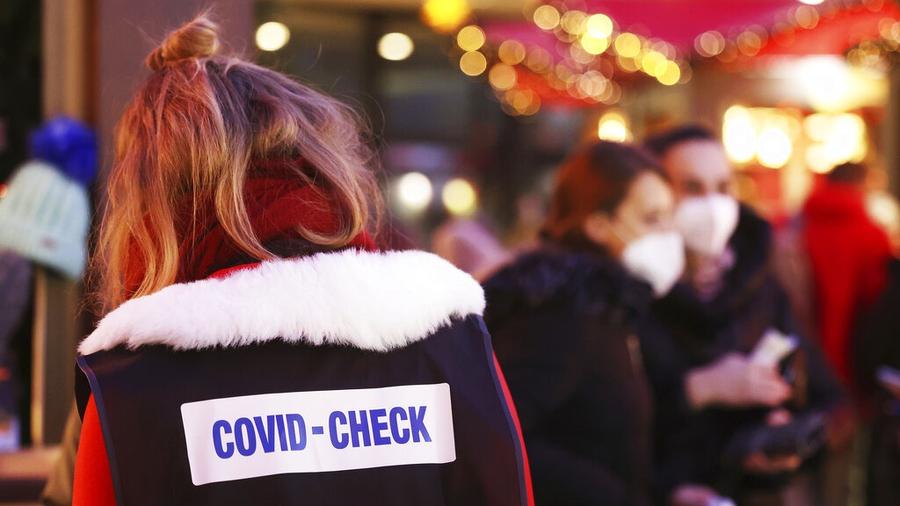
 An inspector appointed by the exhibitors, wearing a sign on her back reading "COVID-Check", walks through Christmas market on Roncalliplatz near the cathedral in Cologne, Germany on Nov 22, 2021. (OLIVER BERG / DPA VIA AP)
NAIROBI / COPENHAGEN / ATHENS / MILAN / BERLIN / WINDHOEK / LOS ANGELES - Following the lifting of most of the country's coronavirus restrictions on Sunday, the seven-day COVID-19 incidence rate in Germany climbed to 1,714 cases per 100,000 people on Monday, the Robert Koch Institute for infectious diseases said.
Germany has lifted all COVID-19 restrictions except the mandatory mask-wearing on public transportation and in care and nursing facilities
The number of daily infections decreased slightly to 92,314 compared to a week ago, according to the RKI.
Germany has lifted all COVID-19 restrictions except the mandatory mask-wearing on public transportation and in care and nursing facilities.
Under the recently amended Infection Protection Act, Germany's federal states can introduce tighter restrictions for infection hotspots. They can reintroduce rules on social distancing or proof of vaccination or recovery requirements.
According to the German Intensive Care Availability Register (DIVI), the number of COVID-19 patients requiring treatment in intensive care units increased by 75 to 2,347 on Monday. This was still well below the record figures logged during the Delta variant wave.
The new Omicron subtype BA.2, which is even more contagious, already became predominant in Germany last week, accounting for nearly two in three infections, the RKI said.
COVID-19 study
Most children and adolescents do not have COVID-19 antibodies in their blood after recovering from a SARS-CoV-2 infection, new data has confirmed.
Starting in October 2020, researchers in Texas recruited 218 subjects between the ages of 5 and 19 who had recovered from COVID-19 infections at some point in the past. Each provided three blood samples, at three-month intervals.
More than 90 percent were unvaccinated when they enrolled in the study. The first blood test showed infection-related antibodies in only one-third of the children, the researchers reported online Friday in Pediatrics. Six months later, only half of those with the antibodies still had them.
The study was designed to detect the presence of antibodies, which are only one component of the immune system's defenses, not the amount of antibodies. The level of protection even in those with antibodies is unclear. Researchers found no differences based on whether a child was asymptomatic, severity of symptoms, when they had the virus or due to weight or gender.
 In this file photo taken on Oct 13, 2021,
Italian Professor Roberto Mezzanotte and a nurse nurse view the lung x-rays of a COVID-19 patient at the Casalpalocco hospital, south of Rome. (ALBERTO PIZZOLI / AFP)
In this file photo taken on Oct 13, 2021,
Italian Professor Roberto Mezzanotte and a nurse nurse view the lung x-rays of a COVID-19 patient at the Casalpalocco hospital, south of Rome. (ALBERTO PIZZOLI / AFP)
Italy
Italy reported 32,573 COVID-19 related cases on Monday, against 60,415 the day before, the health ministry said, while the number of deaths rose to 119 from 93.
Italy has registered 157,904 deaths linked to COVID-19 since its outbreak emerged in February 2020, the second-highest toll in Europe after Britain and the eighth highest in the world. The country has reported 13.89 million cases to date.
Patients in hospital with COVID-19 - not including those in intensive care - stood at 8,728 on Monday, up from 8,430 a day earlier.
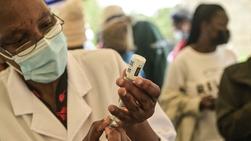 A healthcare worker prepares a dose of Moderna COVID-19 vaccine, during a mass vaccination in Nairobi, on Dec 16, 2021. (SIMON MAINA / AFP)
Kenya
Kenya has so far vaccinated 15.9 million adults against COVID-19, the Ministry of Health said on Monday in a report, putting the country on course to achieve its target of wholly vaccinating 70 percent of its adult population by June.
According to the ministry, 7.9 million people are fully vaccinated with two doses. Kenya plans to fully vaccinate 19 million adults by mid-year and an entire adult population of 27 million people by the end of the year.
The 7.9 million vaccinations mean the east African nation has achieved 42 percent of its target of vaccinating the 19 million adults, the ministry said in a statement.
The ministry said the country's total vaccination of both adults and teenagers stood at 17.3 million. Out of the number, 8.96 million are partially vaccinated.
Kenya targets to inoculate 2.9 million teens (15-17 years) fully by June and the entire teenage population of 5.8 million by end of December.
Namibia
Namibia on Monday held its 32nd Independence Day celebrations at the coastal town of Swakopmund after a two-year break due to the outbreak of the coronavirus.
Speaking at the celebrations, featuring "A people united for prosperity" as its theme, President Hage Geingob said this year's Independence Day celebrations come with an added sense of jubilation because, for the past two years, the country has observed subdued celebrations due to COVID-19.
SK Bioscience
A booster shot of an experimental vaccine being developed by SK Bioscience Co has shown "durable protection" against the Omicron variant in Rhesus macaques, according to new data.
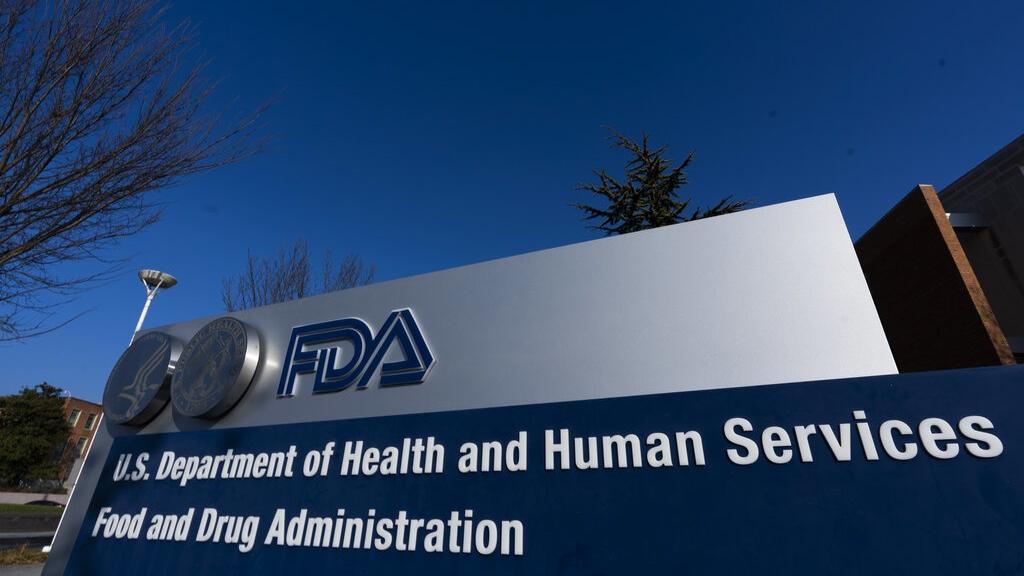 Food and Drug Administration building is shown Thursday, Dec 10, 2020 in Silver Spring, Md. (MANUEL BALCE CENETA / AP)
US
The US drug regulator said on Monday a panel of independent advisers will meet on April 6 to discuss considerations for use of COVID-19 vaccine booster doses.
The US Food and Drug Administration said no vote was planned at this meeting and there will not be any discussion of any of the COVID-19 vaccine makers' applications for additional boosters.
Pfizer and its German partner BioNTech SE, as well as rival Moderna Inc last week sought emergency use authorization from US health regulators for a second COVID-19 booster shot, as a surge in cases in some parts of the world fuels fears of another wave of the pandemic.
The FDA's Vaccines and Related Biological Products Advisory Committee's discussion will focus particularly on factors that need to be looked at to update the strains that make up the vaccines as well as the timing and populations for booster doses.
Meanwhile, nearly 270,000 child COVID-19 cases have been reported in the United States in the past four weeks, according to the report published Monday by the American Academy of Pediatrics and the Children's Hospital Association.
About 12.8 million children have tested positive for COVID-19 since the onset of the pandemic in the country. Children represented 19 percent of all confirmed cases, according to the report.
 In this file photo, the logo of the World Health Organization is seen at the WHO headquarters in Geneva, Switzerland. (PHOTO / AP)
WHO
A new program launched by the World Health Organization's Regional Office for Europe in cooperation with the Greek government on Monday will place the support for and promotion of the quality of mental health care for children and adolescents in all the region's 53 countries "at the heart of the COVID-19 recovery," the office said in a press release.
The launch ceremony in Copenhagen coincided with the inauguration of the WHO Athens Quality of Care Office in Greece's capital.
The program is the result of an ongoing partnership and collaboration between WHO Europe and the government of Greece across the health system spectrum, including the areas of quality of care and patient safety.
"Mental health and well-being is a fundamental human right that should be at the heart of our health systems and key to recovery from the COVID-19 emergency. The pandemic has affected everyone in society, but the most vulnerable, including children and young people, have suffered the most," the WHO's Regional Director for Europe, Dr. Hans Kluge, said. The program will "help to mitigate and reduce the long-term damage this pandemic has done to mental health."
