

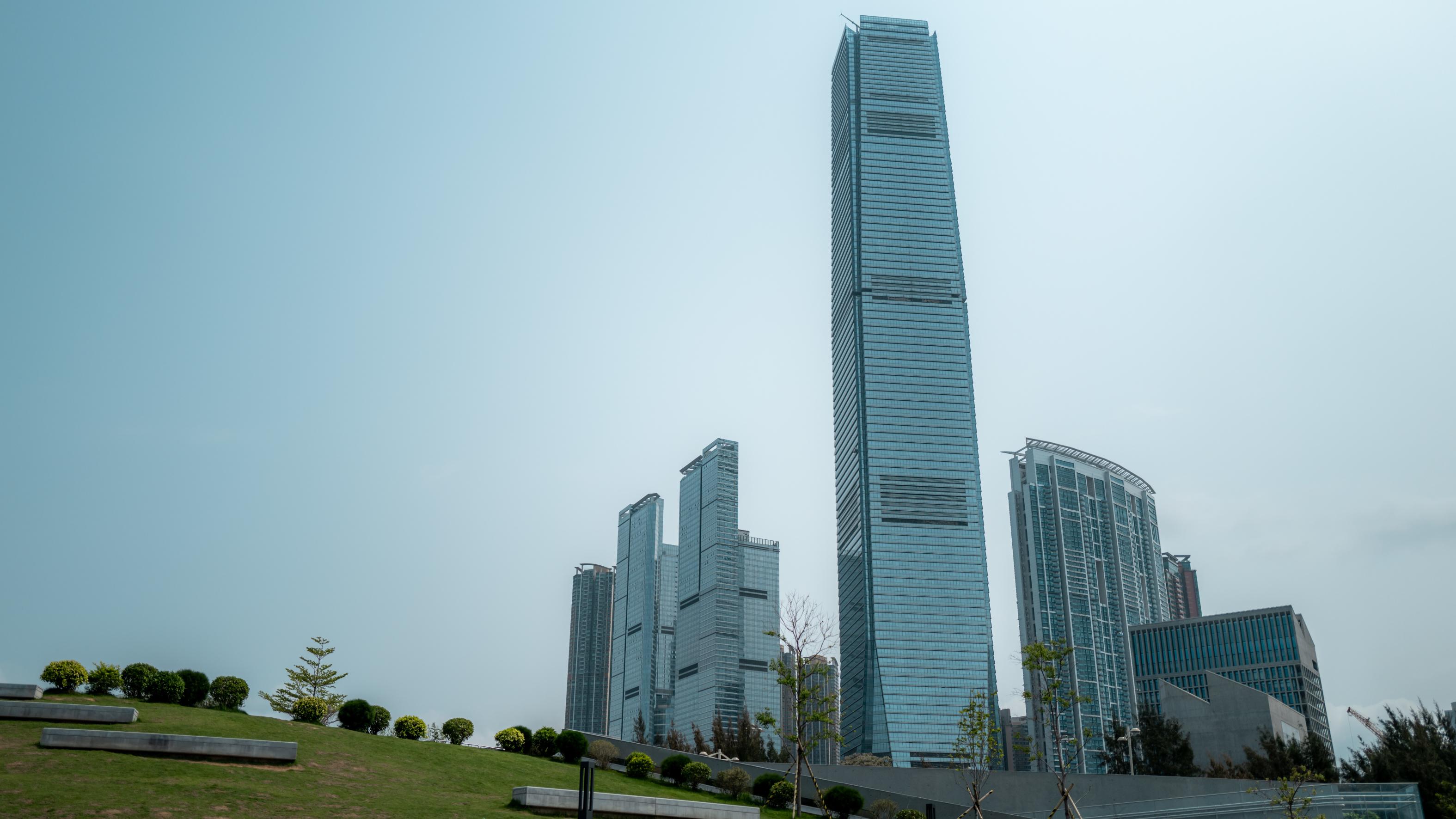
 A general view of International Commerce Centre (ICC) in West Kowloon District, Hong Kong on April 11, 2023. (ANDY CHONG / CHINA DAILY)
Amid a challenging global environment marked by geopolitical risks, elevated interest rates and supply chain disruptions, Hong Kong’s economy has been on a steady path to recovery this year, with the key drivers of growth gaining momentum and global competitiveness strengthened.
The special administrative region government has been working at full stretch to drag the city out of the economic trauma experienced as a result of the three-year COVID-19 pandemic and to steer its economy into the fast lane of growth.
According to the latest official statistics, Hong Kong’s economy expanded by 4.1 percent in the third quarter compared with the same period a year earlier. The growth rate picked up from the second quarter, with a 1.5 percent increase recorded.
“This year, Hong Kong came out of the pandemic with strength. The economy is recovering and people’s incomes are improving,” Chief Executive John Lee Ka-chiu said in his second Policy Address in October.
A series of campaigns and measures, including Hello Hong Kong, Happy Hong Kong and Night Vibes Hong Kong, has been rolled out since the start of the year to attract global visitors and boost local consumption.
The efforts have achieved positive results, with Hong Kong’s inbound tourism and private consumption rebounding strongly.
According to preliminary statistics from the Hong Kong Tourism Board, the city recorded 3.46 million visitor arrivals in October, compared with 80,524 a year earlier. The number of visitors to the city reached 26.8 million in the first 10 months, while the figure for the same period in 2022 was 330,223. The tourism board expects visitor arrivals to hit 30 million for the whole year.
Airlines are bracing for the expansion of their business by increasing fleets and recruiting staff. Hong Kong Airlines said its flight numbers will recover to pre-pandemic levels by the end of the year, surpassing its previous expectations of a full recovery by the middle of 2024. It also anticipates that the average passenger load factor will rebound to 85 percent by year-end. The airline plans to expand its fleet size by 30 percent by the end of next year, doubling its passenger capacity.
Cathay Pacific Airways will hire 4,000 employees this year, representing a 20 percent growth year-on-year. The flagship carrier plans to increase its workforce by a further 5,000 people in the coming year.
Financial Secretary Paul Chan Mo-po said passenger traffic at Hong Kong International Airport will return to 80 percent of pre-pandemic levels this year and is expected to fully recover in 2024.
The surge in inbound travel fueled local consumption. Private consumption expenditures jumped 6.3 percent in the third quarter on a yearly basis and the value of retail sales increased 5.6 percent year-on-year to HK$33.8 billion ($4.3 billion) in October. The city’s jobless rate hit a four-year low before edging up 0.1 of a percentage point to 2.9 percent in the August-through-October period.
To consolidate Hong Kong’s traditional strength in finance and enhance its status as an international financial center, a series of reforms on its stock market have been made or are being considered.
The government has announced it will cut the stamp duty on stock trading from 0.13 percent to 0.1 percent, which will lower the transaction costs of stock transfers and is expected to stimulate the capital market.
Hong Kong Exchanges and Clearing, the city’s bourse operator, has issued a public consultation paper to solicit opinions from institutions and investors about whether to keep local stock and derivatives markets open during severe weather. The arrangement could come into force as early as July.
“Hong Kong’s financial market has a solid foundation and strong resilience. Despite external headwinds, many businesses have still posted positive growth,” Secretary for Financial Services and the Treasury Christopher Hui Ching-yu said.
“The achievements of Hong Kong as an international financial center rest on its unique status under the ‘one country, two systems’ principle, long-standing efforts of the government, regulators and industry, as well as the reputation earned from international investors.”
Total market capitalization of Hong Kong’s security market amounted to HK$30.8 trillion as of the end of October, bouncing back by 17 percent compared with HK$26.4 trillion recorded in the same period last year.
Intensified efforts have also been made to promote investments. The Office for Attracting Strategic Enterprises, which was established in December last year to attract firms with high growth potential to Hong Kong, has reached out to more than 200 strategic enterprises worldwide. Thirty of them are planning to set up offices or expand operations in Hong Kong, which is expected to bring HK$30 billion in new investments to the city and create about 10,000 jobs.
In the first 10 months of the year, InvestHK helped over 333 domestic and overseas enterprises to establish or expand their business in the city, representing a 30 percent year-on-year increase.
“This indicates that Hong Kong, as the first choice for overseas business, has won wide recognition,” Secretary for Commerce and Economic Development Algernon Yau Ying-wah said.
